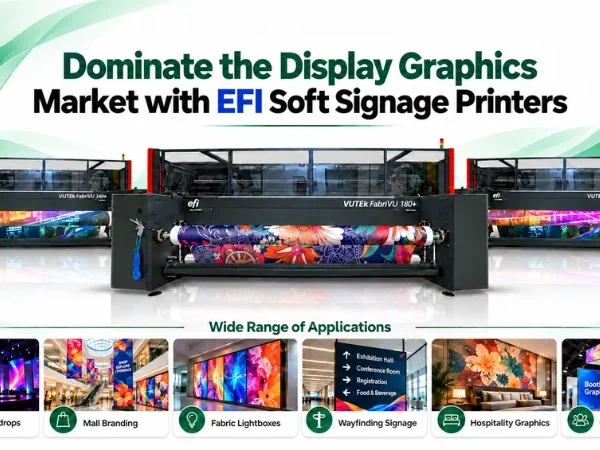
Dominate the Display Graphics Market with EFI Soft Signage Printers
Table of Contents Dominate the Display Graphics Market with EFI Soft Signage Printers EFI VUTEk FabriVU printers let your shop produce fabric display graphics, from
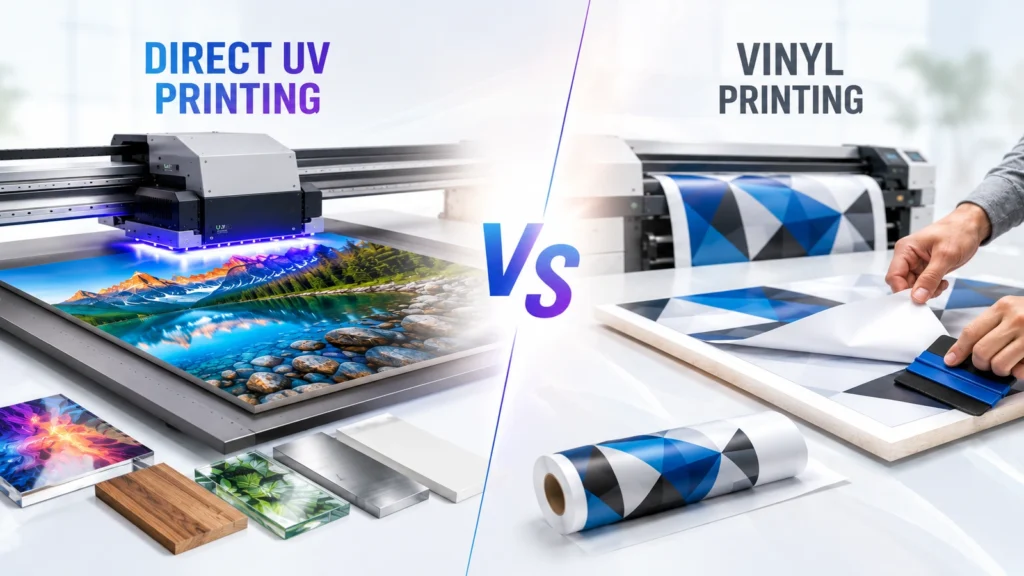
Direct UV printing on rigid substrates is faster, more durable, and more economical than vinyl printing and pasting — with no peeling, no manual labour, and no material waste from application errors.
Direct UV printing applies ink directly to a rigid sheet using UV-cured inkjet technology — no film, no sticker, and no lamination required.
In direct UV printing, a flat rigid substrate — such as sunboard, sunpack, MDF, acrylic, or glass — is fed into a large format flatbed or hybrid printer. The print head deposits UV ink directly onto the surface, and UV lamps or UV LED arrays cure the ink instantly as the head passes over the sheet.
The result is a finished, print-ready sheet in a single machine operation. No additional preparation of the surface is required before or after printing, and no secondary pasting step is needed.
Vinyl printing is a two-step process: artwork is printed on vinyl film, which is then manually applied (pasted) onto the face of a rigid substrate such as sunboard, sunpack, or MDF.
Step one produces a printed vinyl roll or sheet using a roll-to-roll large format printer. Step two requires a skilled operator to align, apply, and smooth the vinyl across the substrate surface without air bubbles, creases, or misalignment.
Any error in the pasting step wastes both the vinyl and the substrate. Complex shapes, curved edges, or large-format sheets amplify the risk of a defective application.
The following terms are used throughout this article and in the large format printing industry when comparing UV direct printing with vinyl application methods.
Term | Definition |
|---|---|
UV Direct Printing | A large format printing process in which ink is applied directly to a rigid substrate (sunboard, sunpack, MDF, acrylic, glass) and instantly cured by UV LED or UV lamp exposure. No film or sticker is applied to the surface. |
Vinyl Printing & Pasting | A two-step process in which artwork is printed on vinyl film and then manually pasted onto the face of a rigid substrate. The vinyl acts as a top layer over the base material. |
UV Curing | The process by which UV light converts liquid UV ink into a solid, scratch-resistant layer. Curing happens instantly as the print head passes over the substrate. |
GreenGuard / GreenGuard Gold | Indoor air quality certifications issued by UL, confirming that a product (or the inks used) emits low levels of volatile organic compounds (VOCs). EFI UV inks carry this certification. |
Hybrid Large Format Printer | A printer capable of handling both roll media (flexible substrates) and rigid flatbed sheets in the same machine without hardware changeover. |
White Ink | An opaque white ink layer used as a base coat (“white under”) on coloured or transparent substrates, or as a top coat (“white over”) on clear media for backlit printing. |
LED Cold-Cure Technology | A UV curing method using LED lamps that emit less heat than conventional UV lamps. Allows printing on heat-sensitive materials such as thin films or foam boards. |
The table below compares UV direct printing and vinyl printing across 11 production and performance dimensions relevant to rigid substrate applications in India.
Dimension | UV Direct Printing | Vinyl Printing & Pasting |
|---|---|---|
Print Speed | ✅ Single-step: print and done | ❌ Two-step: print then paste manually |
Peel / Lifting Risk | ✅ None — ink is UV-cured into the substrate | ❌ High — edges lift over time, especially outdoors |
Outdoor Durability | ✅ High — UV-cured inks resist weather, UV fading | ⚠️ Moderate — depends on vinyl and laminate quality |
Shape Flexibility | ✅ Any shape via digital cut path | ❌ Complex shapes require manual alignment; error-prone |
Labour Requirement | ✅ Minimal — machine-operated | ❌ High — manual pasting; one error = wasted material |
Material Waste | ✅ Low — substrate feeds directly | ❌ Higher — vinyl waste plus substrate if pasting fails |
White Ink Support | ✅ Multi-layer white undercoat and overcoat available | ❌ Limited to printed vinyl; no substrate-level white layer |
Backlit Suitability | ✅ White diffuser layer achievable for even illumination | ⚠️ Possible with backlit vinyl, but less precise |
Sustainability | ✅ GreenGuard / GreenGuard Gold (EFI UV inks) | ⚠️ No comparable certification standard |
Heat-Sensitive Media | ✅ Compatible via LED cold-cure UV technology | ⚠️ Substrate must tolerate heat from standard printers |
Originality of Substrate | ✅ Base material remains visible and authentic | ❌ Substrate surface is fully covered by vinyl film |
UV direct printing outperforms vinyl printing on rigid substrates across speed, durability, shape flexibility, white ink capability, and sustainability credentials.
Direct UV printing completes the job in one machine pass. Vinyl printing requires two separate production steps — printing the vinyl and pasting it to the substrate — each with its own setup time, drying or curing time, and labour cost.
A single operator error during vinyl application can destroy both the vinyl print and the substrate, making the entire job a write-off. Direct UV printing eliminates this failure point entirely.
UV-cured ink bonds at a molecular level with the substrate surface. There is no adhesive interface, no edge to lift, and no layer to peel. This makes UV-printed rigid panels significantly more durable than vinyl-applied equivalents, particularly in outdoor and high-humidity environments.
EFI Genuine UV inks further extend outdoor durability by resisting UV fading, moisture, and temperature variation — without the need for additional laminate protection.
Achieving irregular or non-rectangular shapes with vinyl pasting requires precise manual alignment of the vinyl to the cut shape — a time-consuming process where misalignment wastes materials. With UV direct printing, the substrate is printed first and then cut digitally to any shape, with no alignment risk.
Digital cutting after UV printing preserves the original surface material on non-printed areas, maintaining the authenticity of the substrate — an effect impossible to achieve when the entire surface is covered by vinyl.
UV direct printing supports multi-layer white ink — a capability that vinyl printing cannot match at the substrate level. White ink applied as an undercoat (“white under”) allows full-colour artwork to render accurately on dark, coloured, or metallic substrates, without the colour shift caused by the base material showing through.
White ink applied as an overcoat (“white over”) on clear acrylic or glass creates a diffusion layer ideal for backlit display panels — spreading the backlight evenly for consistent illumination across the print surface.
EFI UV inks carry GreenGuard and GreenGuard Gold certifications, confirming low VOC emissions suitable for indoor display and signage environments. These certifications can support sustainability claims in client-facing print production.
Vinyl printing does not carry an equivalent industry-standard certification for indoor VOC performance.
EFI VUTEk hybrid large format printers are designed for high-volume rigid substrate production, combining flatbed and roll-to-roll capability in a single machine.
EFI VUTEk hybrid flatbed printers handle roll media and rigid substrates from the same platform, eliminating hardware changeover time between job types. LED cold-cure UV technology in these systems enables printing on heat-sensitive materials including thin foam boards and soft PVC — substrates that conventional UV printers damage.
Arrow Digital India supplies and supports EFI VUTEk hybrid and flatbed UV large format printers across Ahmedabad, Mumbai, Delhi, Bengaluru, Pune, Kolkata, Indore, and Surat. Contact Arrow Digital for a product demonstration or media test on your substrate.
Common questions from print buyers and production managers evaluating UV direct printing against vinyl printing and pasting for rigid substrate applications.
Yes. UV direct printing completes the job in a single machine pass. Vinyl printing requires a separate print run on vinyl film followed by manual pasting — adding labour time and the risk of errors during application. |
No. UV-cured ink bonds directly to the substrate surface and does not peel, lift, or flake. Vinyl edges are prone to lifting, especially in outdoor or high-humidity environments. |
Yes, when equipped with LED cold-cure UV technology. LED UV lamps emit significantly less heat than conventional UV lamps, making them safe for thin foam boards and other heat-sensitive rigid media. |
White ink serves two functions: as an undercoat (“white under”) to make colours pop on dark or coloured substrates, and as an overcoat (“white over”) on clear acrylic or glass for backlit display printing. It also acts as a diffuser to spread light evenly in backlit panels. |
EFI UV inks carry GreenGuard and GreenGuard Gold certifications, confirming low VOC emissions suitable for indoor environments. Consult your equipment supplier for the specific ink formulation in use. |
UV large format printers can print directly on sunboard, sunpack, MDF, acrylic, glass, aluminium composite panels, PVC foam board, corrugated plastic, and other flat rigid sheets up to the machine’s maximum thickness and weight capacity. |
A hybrid UV printer can process both roll media and rigid flatbed sheets without hardware changeover. It is best suited for print shops that handle a mix of flexible media (banners, canvas, backlit film) and rigid substrates (boards, panels, signage) in the same production environment. |
Table of Contents Dominate the Display Graphics Market with EFI Soft Signage Printers EFI VUTEk FabriVU printers let your shop produce fabric display graphics, from
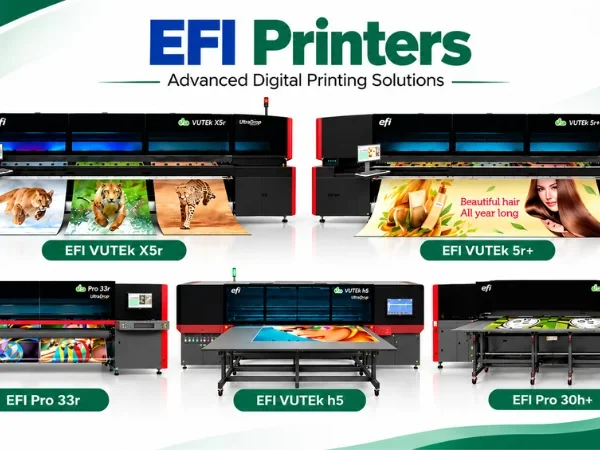
Table of Contents 7 Reasons to Buy EFI Printers for Your Print Business in India EFI printers let one print business serve signage, soft signage,
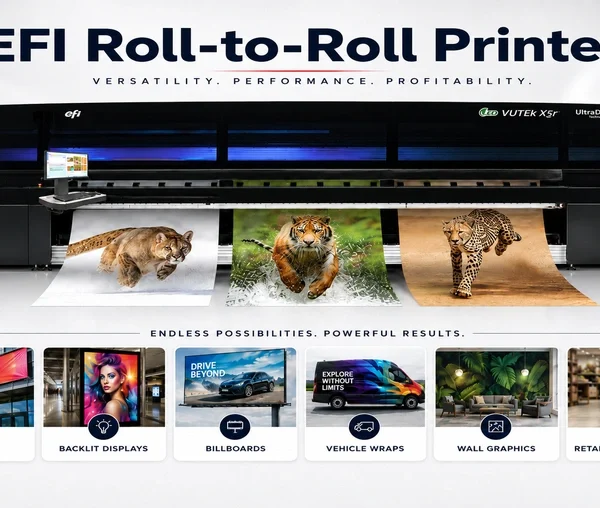
Table of Contents Why You Need EFI Roll-to-Roll Printers for Special Applications EFI VUTEk roll-to-roll printers become all-in-one production platforms with value-added accessories for finishing,
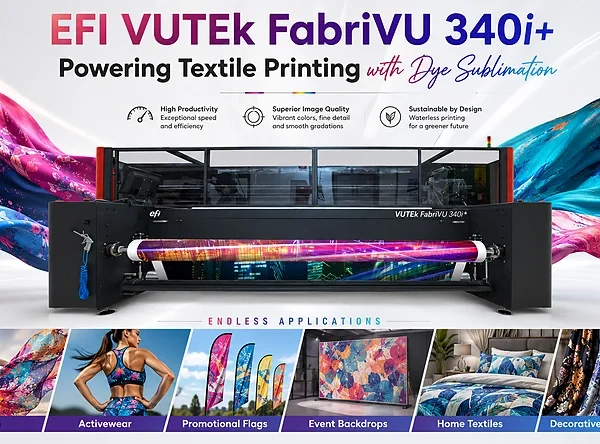
Table of Contents EFI VUTEk FabriVU 340i+ Dye Sublimation: A Great Choice for Textile Printing The EFI VUTEk FabriVU 340i+ prints and fixes fabric graphics
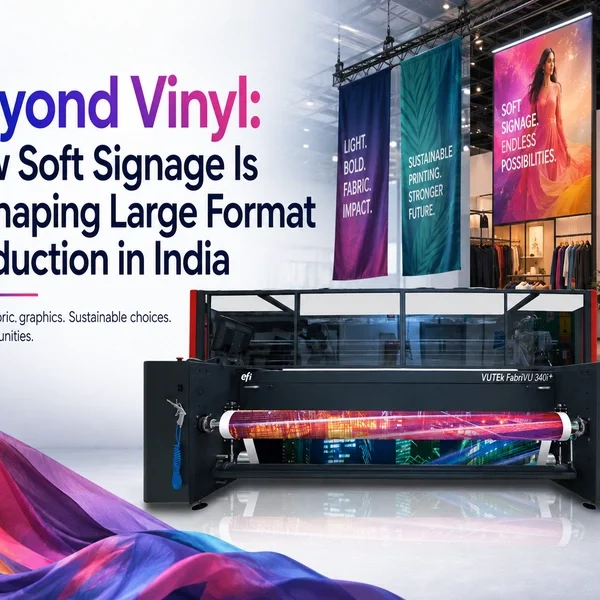
Table of Contents Beyond Vinyl: How Soft Signage Is Reshaping Large Format Production in India Print buyers across retail, events, and hospitality have been moving
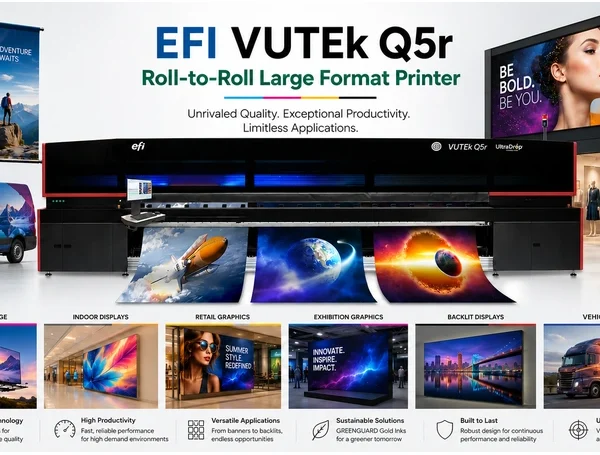
Table of Contents EFI VUTEk Q5r Roll-to-Roll Large Format Printer:Production Capabilities and Ink Options India’s large format print market is being shaped by one consistent
Discover new ways to print and finish labels with Arrow Digital.
Explore aqueous pigment printing, flexible short runs and precision die-cutting.
2026 · THURSDAY–SUNDAY
Greater Noida, Delhi NCR.