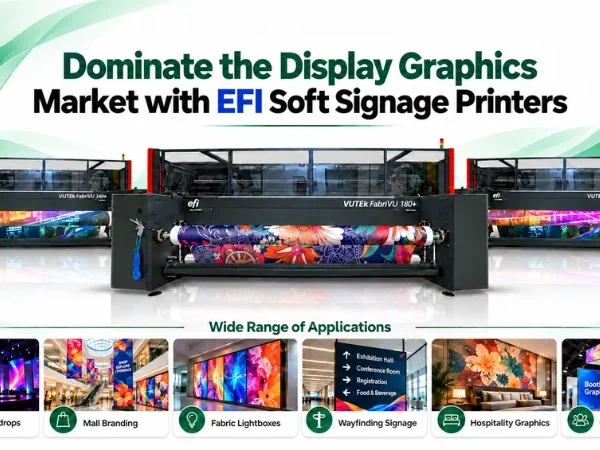
Dominate the Display Graphics Market with EFI Soft Signage Printers
Table of Contents Dominate the Display Graphics Market with EFI Soft Signage Printers EFI VUTEk FabriVU printers let your shop produce fabric display graphics, from

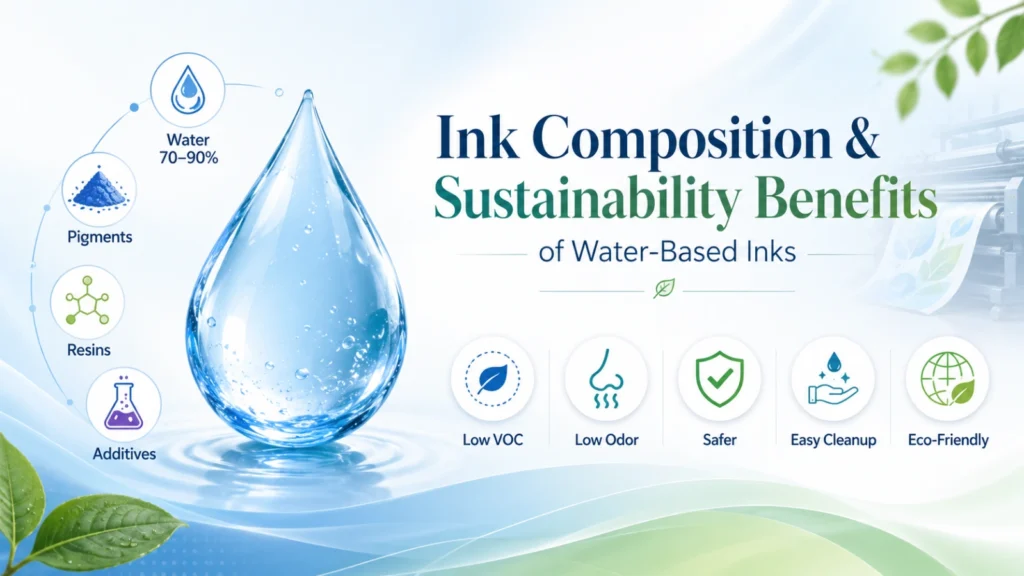
Water-based inks use water as the carrier fluid — delivering vibrant, durable label prints with near-zero VOC emissions.
For label printers investing in digital printing equipment, ink choice directly affects print quality, regulatory compliance, and total operating cost. Water-based inks are increasingly the standard for food, beverage, pharmaceutical, and cosmetic label production in India — and understanding their composition helps you evaluate which press best fits your production requirements.
Water-based inks replace chemical solvents with water as the primary carrier, making them safer, lower-odour, and more environmentally compliant than solvent or UV alternatives.
Unlike solvent-based inks — which release harmful volatile organic compounds (VOCs) during printing and drying — or UV inks that require energy-intensive curing lamps, water-based inks air-dry naturally. This makes them compatible with heat-sensitive substrates and simpler to handle in production environments.
For equipment buyers evaluating label press investment, water-based ink compatibility is a key specification to confirm — particularly for productions serving regulated industries such as food packaging, pharmaceuticals, and cosmetics.
Water-based inks consist of four functional components: pigments, resins, additives, and water — each serving a distinct role in print quality and substrate performance.
Pigments | High-quality colour particles that determine print vibrancy, sharpness, and fade resistance. Pigment-based formulations outperform dye-based inks for outdoor durability and archival longevity. |
Resins & Binders | Polymer chains that bond the pigment to the substrate surface. Resin selection governs adhesion performance on different label stocks — paper, film, foil, and uncoated materials. |
Additives | Functional agents that control viscosity, flow rate, surface tension, and press stability. Additives are tuned for high-speed digital presses to maintain consistent drop placement. |
Water (Carrier) | The primary carrier fluid, replacing chemical solvents. Water evaporates cleanly during drying, leaving behind only the pigment-binder layer — with no solvent residue on the print surface. |
This comparison covers the key operational and compliance differences between the three main inkjet ink types used in label and packaging production.
Feature | Water-Based Inks | Solvent-Based Inks | UV Inks |
|---|---|---|---|
Carrier fluid | Water | Chemical solvents | Photo-initiators (UV-cured) |
VOC emissions | Very low / near zero | High | Low–medium |
Odour | Minimal | Strong / hazardous | Moderate |
Energy (curing) | Air-dry — no lamp needed | Air-dry with VOC extraction | UV lamp required |
Food / pharma safe | Yes (FDA-compliant options) | Not recommended | Depends on formulation |
Substrate range | Paper, film, foil, uncoated | Vinyl, banners, outdoor media | Most rigid & flexible substrates |
Inline finishing | Priming + varnishing supported | Limited | Varnish options available |
Typical application | Label & flexible packaging | Wide-format signage | Commercial & industrial labels |
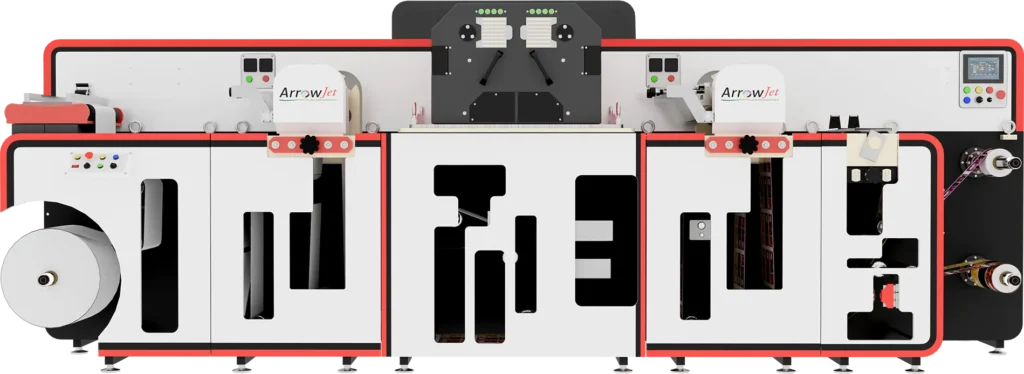
Arrow Digital’s ArrowJet label printers are water-based ink systems optimised for label and flexible packaging production. Contact our team for ink compatibility data for your specific substrate.
Water-based inks emit near-zero VOCs during printing — reducing workplace air quality risk and easing compliance with environmental regulations.
Solvent-based inks release volatile organic compounds continuously during printing and drying. These emissions require extraction systems, create disposal obligations, and may trigger local pollution control compliance. Water-based inks eliminate this burden.
In food and pharmaceutical packaging specifically, water-based inks are often the only technically viable option to meet FSSAI requirements and international standards such as the Swiss Ordinance for indirect food contact. Verify specific compliance requirements with your regulatory team before making production claims.
Inline priming and varnishing integrates substrate preparation and surface finishing into a single press pass — reducing secondary equipment needs and cycle time.
A primer coat prepares challenging substrates — film, foil, uncoated paper — for optimal ink adhesion before the print head applies ink. Inline priming expands the range of label materials a press can handle without requiring pre-treated stocks, directly reducing material cost.
An inline varnish unit applies a protective overcoat — matte, gloss, or spot effect — in the same production pass as printing. This eliminates a separate offline varnishing step, reduces handling time, and produces shelf-ready labels in one continuous workflow.
The ArrowJet Bolt 330R Hybrid Pro M supports inline priming and varnishing as standard, enabling label converters to produce finished, lamination-quality labels without secondary processes.
Water-based ink systems air-dry without UV lamps — lowering energy consumption per metre of print and reducing the chemical load in press maintenance cycles.
UV ink systems require high-intensity UV curing lamps that draw significant power continuously. Water-based drying is passive — heat-assisted or ambient air — which reduces energy draw during production runs. For high-volume label press operations, this difference compounds into meaningful cost savings over time.
Cleanup cycles for water-based systems use water and minimal cleaning agents rather than solvent flushes, reducing chemical consumption and the volume of waste requiring specialist disposal.
When combined with on-demand digital print workflows — printing exactly the quantity needed — water-based label presses eliminate overproduction waste entirely. ArrowJet systems including the Aqua 330R and Nova 250R are optimised for short-run on-demand production.
Modern water-based ink formulations match or exceed solvent ink durability for indoor and many outdoor label applications — including fade, scratch, and moisture resistance.
Common questions from label press buyers and production managers evaluating water-based ink technology.
Yes. Water-based inks with low-migration formulations are the preferred choice for food and beverage label printing. They produce near-zero VOC emissions and are available in FDA-compliant options for indirect food contact. Verify specific FSSAI compliance requirements with your regulatory team before production.
For indoor label applications — retail, cold chain, pharmaceutical — water-based inks deliver comparable durability to UV inks when paired with inline varnishing. UV inks retain a durability advantage for extreme outdoor or chemical-exposure applications. Arrow Digital’s team can advise on the right ink type for your specific label application.
Yes. ArrowJet label press systems — including the Aqua 330R, Nova 250R, and Bolt 330R Hybrid Pro M — are designed around water-based aqueous inkjet technology. The Bolt also supports inline priming and varnishing for end-to-end label production.
Inline varnishing is available on the ArrowJet Bolt 330R Hybrid Pro M. Other ArrowJet models support water-based inks and on-demand print workflows; finishing options vary by model. Contact Arrow Digital for a model-by-model specification comparison.
With appropriate inline priming, water-based inks print on self-adhesive paper, BOPP film, polyester, foil, and uncoated stock. Inline priming expands substrate compatibility without requiring pre-treated materials, reducing stock SKUs.
Solvent-based inks typically emit 300–700 g/L of VOCs during printing. Water-based inks emit near-zero VOCs — generally below 5 g/L — eliminating the need for solvent extraction systems and reducing workplace health risk for press operators.
Arrow Digital manufactures and supplies water-based digital label press systems across India — including ArrowJet Aqua, Nova, and Bolt series.
To evaluate whether a water-based label press fits your production requirements — substrate range, run lengths, finishing needs, and compliance standards — speak with our technical team for a specification review and live demonstration.
Table of Contents Dominate the Display Graphics Market with EFI Soft Signage Printers EFI VUTEk FabriVU printers let your shop produce fabric display graphics, from
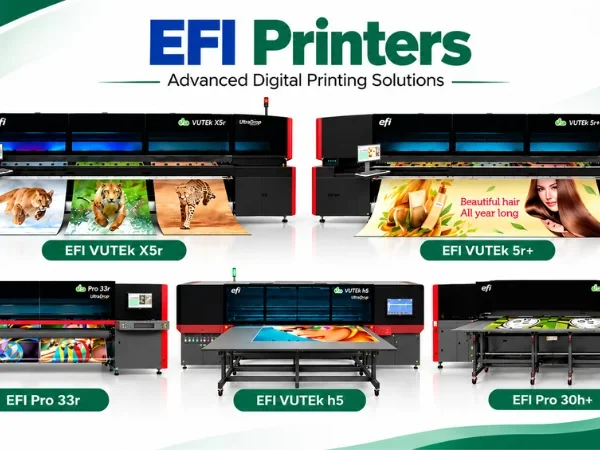
Table of Contents 7 Reasons to Buy EFI Printers for Your Print Business in India EFI printers let one print business serve signage, soft signage,
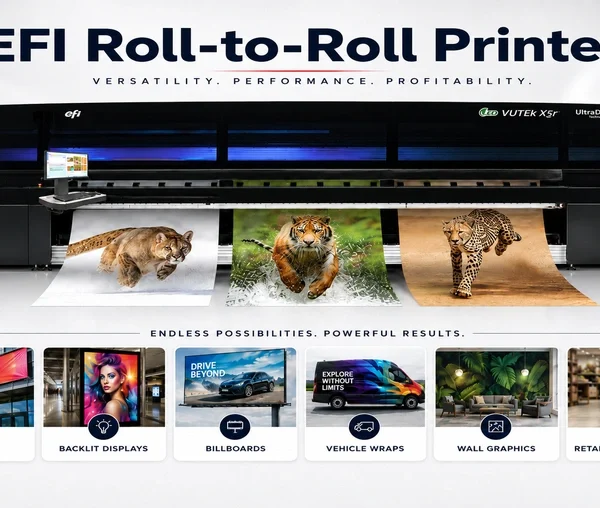
Table of Contents Why You Need EFI Roll-to-Roll Printers for Special Applications EFI VUTEk roll-to-roll printers become all-in-one production platforms with value-added accessories for finishing,
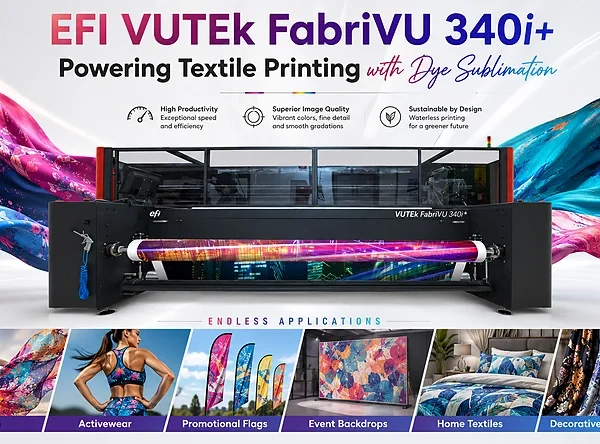
Table of Contents EFI VUTEk FabriVU 340i+ Dye Sublimation: A Great Choice for Textile Printing The EFI VUTEk FabriVU 340i+ prints and fixes fabric graphics
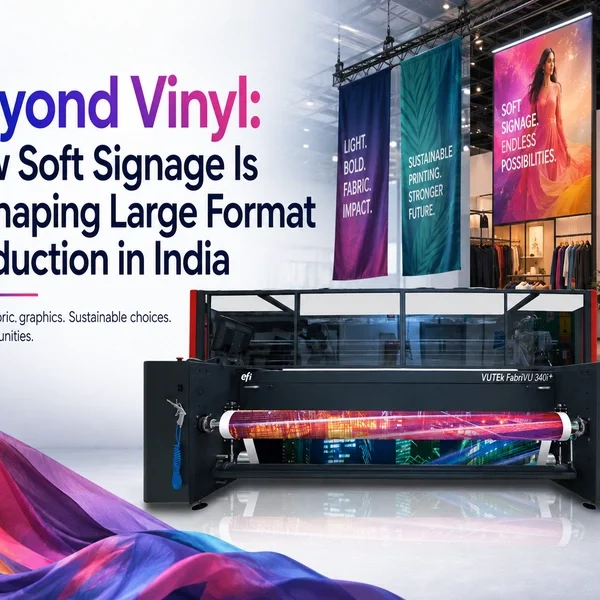
Table of Contents Beyond Vinyl: How Soft Signage Is Reshaping Large Format Production in India Print buyers across retail, events, and hospitality have been moving
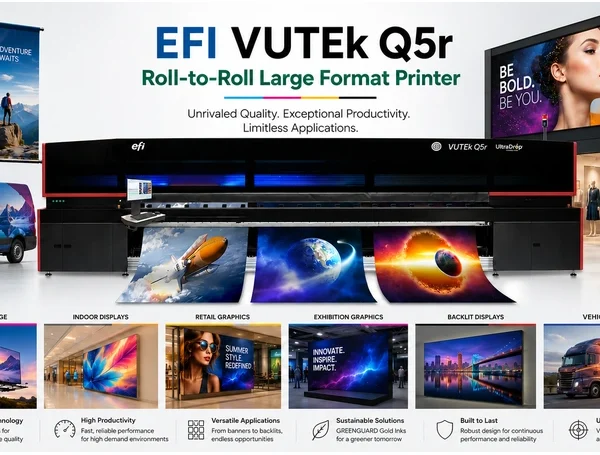
Table of Contents EFI VUTEk Q5r Roll-to-Roll Large Format Printer:Production Capabilities and Ink Options India’s large format print market is being shaped by one consistent