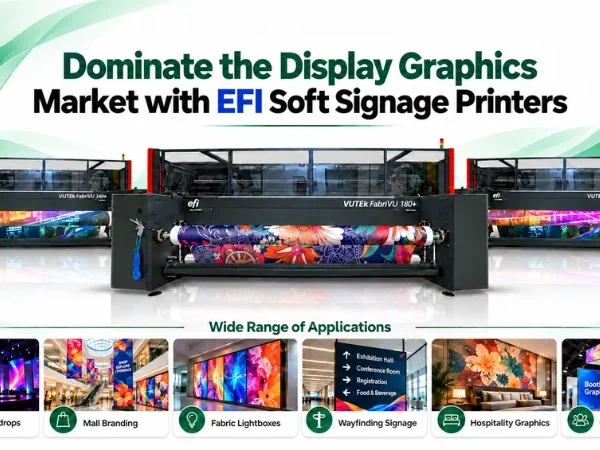
Dominate the Display Graphics Market with EFI Soft Signage Printers
Table of Contents Dominate the Display Graphics Market with EFI Soft Signage Printers EFI VUTEk FabriVU printers let your shop produce fabric display graphics, from


India is the fastest-growing inkjet printing market in the world. That’s not a guess. It’s the main finding from Smithers’ report, “The Future of Inkjet Printing to 2031” — one of the most detailed studies of the global printing industry available. India’s inkjet market is expected to grow at 5.6% per year through 2031. That puts India ahead of China (5.2%), the USA (5.0%), Germany (4.6%), and Japan (4.2%). If you work in label printing in India — whether you already run a press or are thinking about buying one — this data matters to your next investment decision.
The question is no longer whether digital inkjet printing is the future. The data makes that clear. The more useful question is what it means for you. Are you a label converter thinking about upgrading your equipment? Or a brand owner thinking about printing your own labels for the first time? The market numbers are the same for both. What changes is what you do next.
The global inkjet printing market is going through one of the biggest changes in its history. According to the Smithers report, the market is worth around $130 billion in 2026. By 2031, it is expected to reach $177.3 billion. That growth is split across two main areas.
Table 1: Global Inkjet Market Segments by 2031 (Source: Smithers, “The Future of Inkjet Printing to 2031”)
Market Segment | 2031 Value | CAGR | Primary Growth Drivers |
|---|---|---|---|
Graphics & Packaging | $134.6 billion | 5.9% | E-commerce, web-to-print, packaging versioning |
Industrial & Functional | $42.7 billion | 7.9% | Printed electronics, textiles, on-demand décor |
Total Inkjet Market | $177.3 billion | ~6.3% | AI integration, sustainability, APAC expansion |
Graphics and Packaging — which includes labels, flexible packaging, corrugated boxes, and commercial printing — makes up the larger share. It is expected to reach $134.6 billion by 2031, growing at 5.9% per year. Industrial and Functional printing — things like textiles, electronics, and decorative surfaces — is smaller but growing faster at 7.9% per year.
Both areas are being driven by the same shift: businesses moving away from old analogue printing methods like offset and flexo, and switching to digital inkjet. The benefits of inkjet printing over conventional methods are being accelerated by three things. First, companies need more flexibility after supply chain disruptions during the pandemic. Second, e-commerce is growing fast and brands need shorter print runs with more variations. Third, environmental rules are pushing businesses toward cleaner, less wasteful printing methods.
One of the biggest trends in the Smithers report is this: the centre of the global inkjet market is moving east. In 2021, North America had the largest share of global inkjet volume — 35.6%. By 2026, Asia-Pacific will have overtaken it. By 2031, Asia-Pacific will lead on every measure.
Within Asia-Pacific, India is the top performer. The Smithers data shows that India’s growth is being pushed by two things: more small and medium businesses being set up, and a major expansion in manufacturing and industrial infrastructure. India’s printing ink market alone grew by nearly 20% in value between 2013 and 2024.
Table 2: APAC Country Projections 2026–2031 (Source: Smithers, “The Future of Inkjet Printing to 2031”)
Country | CAGR 2026–2031 | Primary Growth Catalyst | Regional Role |
|---|---|---|---|
India | 5.6% | SME growth, infrastructure buildout | Leading growth rate |
China | 5.2% | Industrial manufacturing, e-commerce | Largest volume consumer |
USA | 5.0% | Premium positioning, tech innovation | Mature market transition |
Germany | 4.6% | Industrial engineering, specialty inks | European regulatory leader |
Japan | 4.2% | High-end electronics, export focus | Primary ink technology exporter |
This growth is coming from manufacturing — the same industry that buys and uses label printing equipment. Whether you are a label converter looking to grow your capacity, or a brand owner thinking about your first press, the signal is the same: the market that will absorb that investment is growing faster in India than anywhere else in the world. For a broader view of where the market is heading, see our overview of emerging trends in labels and flexible packaging.
Out of all inkjet applications — textiles, corrugated boxes, flexible packaging, printed electronics — the Smithers report says labels were the first to go digital. And they are now the most established. Narrow-web digital label presses are now standard equipment around the world. Print speeds and colour quality have improved to the point where brands requiring fast turnaround and short print runs prefer them.
This is not a new or unproven technology. Businesses in Europe, North America, and across Asia-Pacific have already made the switch. For label converters in India, this is important: it means the equipment works, the substrates are well understood, and customer demand for short-run digital label jobs is here to stay — it’s not a temporary trend. For brand owners thinking about their first press, it means they are not taking a risk on something new. They are adopting a technology that is already proven globally.
Flexible packaging is identified by Smithers as the next big growth area for inkjet. It’s not fully there yet — there are still technical challenges around certain inks and substrates. But it’s growing. To understand the growing Indian market for flexible packaging, for manufacturers who plan to move into flexible packaging in the future, building label printing capability now is a logical first step.
The Smithers report doesn’t just show how big the market is getting. It also maps out where the technology is heading through 2031. If you are buying equipment, these trends tell you what to look for — and what to avoid.
Table 3: Technology Direction 2026–2031 and Impact for Indian Manufacturers (Source: Smithers, “The Future of Inkjet Printing to 2031”)
Technology Area | Today’s Standard | Direction by 2031 | Impact on Indian Manufacturers |
|---|---|---|---|
Press Format | Multi-purpose / scanning | Single-pass / purpose-built narrow-web | Higher throughput; lower cost per label at volume |
Curing Method | Mercury vapour UV | LED-UV | Lower energy costs; print on heat-sensitive substrates |
Ink Chemistry | Solvent / conventional UV | Water-based / low-migration | Regulatory compliance; broader food & pharma applicability |
Quality & Uptime | Manual inspection | AI nozzle monitoring + inline inspection | Fewer stoppages; reduced waste; narrowing cost gap vs flexo |
Purpose-Built Presses Are Replacing General-Purpose Machines
The industry is moving away from presses that try to do everything, and toward presses built for one job. For label printing, this means presses designed purely for narrow-web labels. These purpose-built machines are faster and more consistent. Many businesses are replacing multiple older machines with one or two of these newer, more capable presses.
LED-UV Is Replacing Old UV Curing
Traditional UV curing uses mercury vapour lamps. LED-UV is the newer option — and it’s taking over. It uses less energy. It produces less heat, which matters when printing on thin or heat-sensitive label materials. The curing unit also lasts longer. For Indian manufacturers where electricity costs are a real concern, this change directly affects the daily cost of running a press.
AI Is Closing the Cost Gap with Flexo
This is the most important trend for anyone comparing digital versus conventional printing costs. AI systems can now monitor every printhead nozzle in near-real time. If one starts to fail, the press fixes it automatically without stopping. Cameras check print quality inline and catch problems before they create waste. Scheduling software keeps every press running as efficiently as possible. By 2031, all of this is expected to be standard on inkjet presses. That means digital printing will be cost-competitive at longer and longer run lengths — ones that used to belong exclusively to flexo.
India’s e-commerce market is growing fast. Platforms like Zepto and Blinkit have changed what brands need from their labels. Today, brands need shorter print runs, more label variants, faster turnaround, and frequent artwork changes. This is exactly the kind of work that digital label printing handles best. But what this means in practice depends on which side of the press you are on.
For Label Converters and Trade Printers
The growth projections in the Smithers report point directly to more business coming your way. Brands are placing more orders — but in smaller quantities and with more variations. That is good news if you have the right equipment. It is a problem if you are still running older analogue machines or general-purpose presses. Those machines were built for long, stable runs. They are slow and expensive to set up for short jobs. As customers order smaller quantities more often, that mismatch gets more costly.
The technology shift the Smithers report describes — purpose-built presses, LED-UV curing, AI quality monitoring — is not something to plan for later. It is the standard your competitors will be working toward over the next five years. The businesses that upgrade now will be faster, cheaper to run, and better placed to win short-run orders.
For Brand Owners and Manufacturers
The same shift that is pushing label converters to upgrade is also changing the maths on outsourcing. If you send your label jobs to a trade printer today, you are paying their minimum order quantities, waiting on their lead times, and managing your artwork changes through someone else’s process. As your label needs grow more varied and more frequent — more SKUs, more campaigns, more regional versions — those costs add up fast. See how other manufacturers have approached the decision to bring label printing in-house.
India’s inkjet market is expected to grow at 5.6% per year. India’s print ink market grew by 20% in value over the last decade. The demand for labels is already here and growing. Whether you are a label converter thinking about a press upgrade or a brand owner thinking about your first press, the market is pointing in the same direction. The window is open. The demand to support that investment is already there.
Yes. According to Smithers’ “The Future of Inkjet Printing to 2031,” India’s inkjet market is expected to grow at 5.6% per year between 2026 and 2031. That is the fastest growth rate of any major market in the world — faster than China (5.2%), the USA (5.0%), Germany (4.6%), and Japan (4.2%). The growth is coming from more small businesses being set up, more manufacturing infrastructure being built, and rising demand for short-run, personalised label work from FMCG and e-commerce brands.
The Smithers report says narrow-web digital label printing is already the most established inkjet application globally. Between now and 2031, the technology is moving toward presses built for one specific job, LED-UV curing, and AI systems that monitor quality and reduce waste. For label converters, this means now is the right time to consider upgrading older or general-purpose equipment. For brand owners, it means the case for in-house label printing gets stronger every year as the technology improves and costs come down.
India leads. Its inkjet market is expected to grow at 5.6% per year between 2026 and 2031 — the highest of any major country. China comes second at 5.2%, followed by the USA at 5.0%, Germany at 4.6%, and Japan at 4.2%. Across the whole Asia-Pacific region, the market is set to overtake North America in both volume and value by 2026.
Not completely — and not for every job. Digital inkjet is taking over from flexo mainly for short runs, jobs with frequent artwork changes, and orders with many label variants. For these jobs, digital is faster to set up and has no plate costs. For very long runs with stable artwork, flexo still works out cheaper. But as AI tools improve the economics of digital printing, the run length at which digital becomes cost-competitive will keep increasing. This matters both for converters running mixed operations and for brand owners calculating whether to invest in their own press.
Arrow Digital is an Indian manufacturer of digital label printing and large format printing equipment. The company is based in India and sells directly to the Indian market.
Arrow Digital designs and manufactures the ArrowJet range of digital label printing equipment in India — with UV and aqueous ink options across narrow-web and production press formats. Arrow Digital has completed 500+ press installations across India and has a pan-India service network. That means local engineers, faster response times, and support from people who understand Indian production environments.
The technology changes the Smithers report describes — purpose-built presses, LED-UV curing, AI quality monitoring — are not things Arrow Digital is watching from the outside. They are what the ArrowJet platform was built to do, for Indian businesses, at costs that work for the Indian market. When Smithers names India as the world’s fastest-growing inkjet market, Arrow Digital is the domestic manufacturer with the capacity and network to support that growth.
Whether you are a label converter looking at a press upgrade, a brand owner considering your first press, or a business reviewing your current equipment against today’s technology options, Arrow Digital’s team will work through the process with you directly — from understanding your substrate and run-length needs to installation and operator training.
Whether you are a label converter evaluating a press upgrade or a manufacturer considering in-house label printing for the first time — Arrow Digital’s team works through the specification, economics, and installation process with you directly.
Table of Contents Dominate the Display Graphics Market with EFI Soft Signage Printers EFI VUTEk FabriVU printers let your shop produce fabric display graphics, from
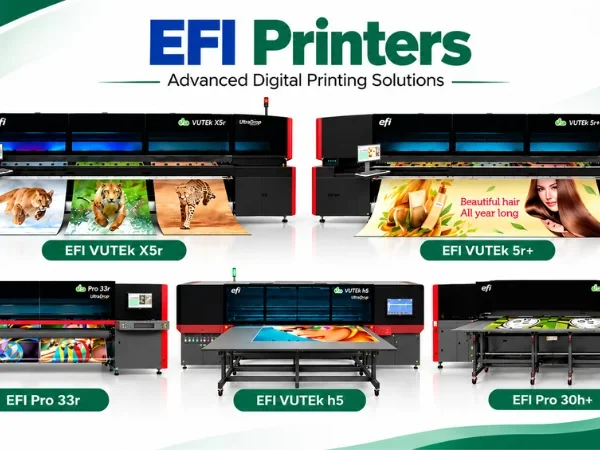
Table of Contents 7 Reasons to Buy EFI Printers for Your Print Business in India EFI printers let one print business serve signage, soft signage,
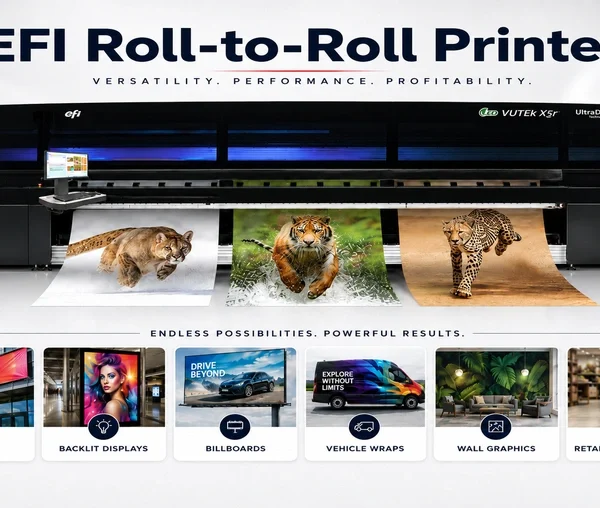
Table of Contents Why You Need EFI Roll-to-Roll Printers for Special Applications EFI VUTEk roll-to-roll printers become all-in-one production platforms with value-added accessories for finishing,
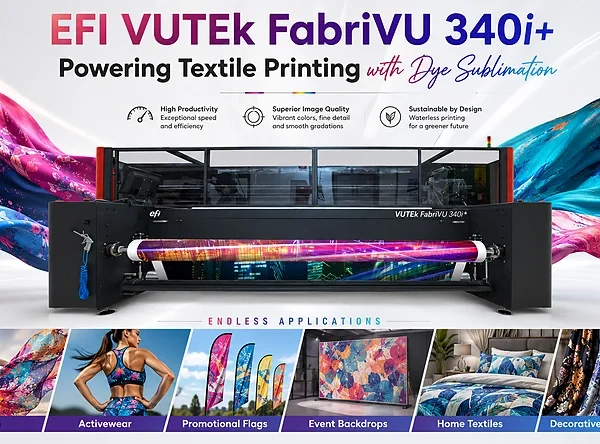
Table of Contents EFI VUTEk FabriVU 340i+ Dye Sublimation: A Great Choice for Textile Printing The EFI VUTEk FabriVU 340i+ prints and fixes fabric graphics
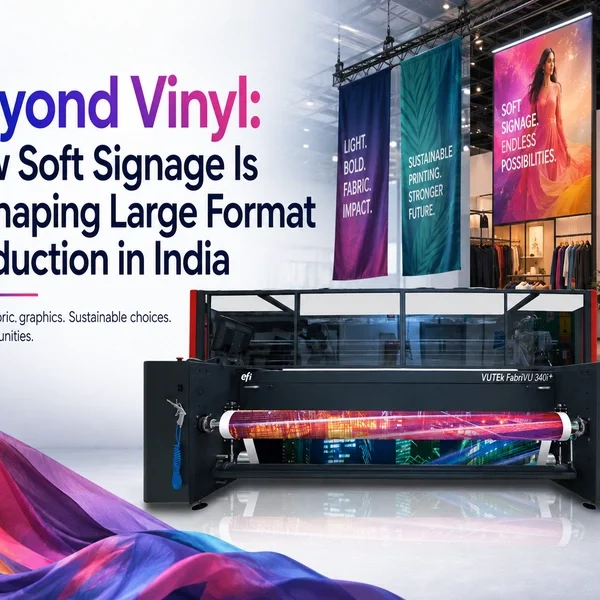
Table of Contents Beyond Vinyl: How Soft Signage Is Reshaping Large Format Production in India Print buyers across retail, events, and hospitality have been moving
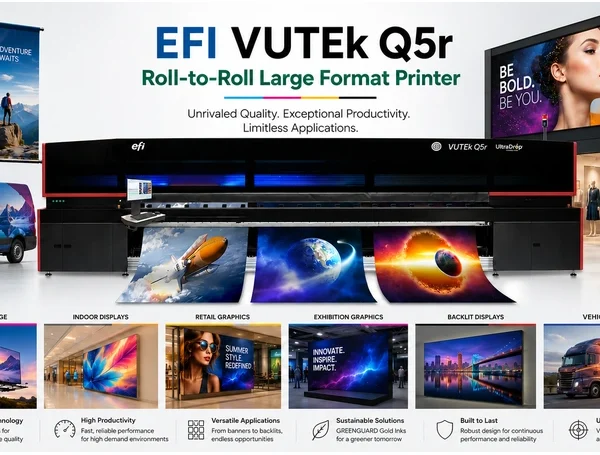
Table of Contents EFI VUTEk Q5r Roll-to-Roll Large Format Printer:Production Capabilities and Ink Options India’s large format print market is being shaped by one consistent
Discover new ways to print and finish labels with Arrow Digital.
Explore aqueous pigment printing, flexible short runs and precision die-cutting.
2026 · THURSDAY–SUNDAY
Greater Noida, Delhi NCR.