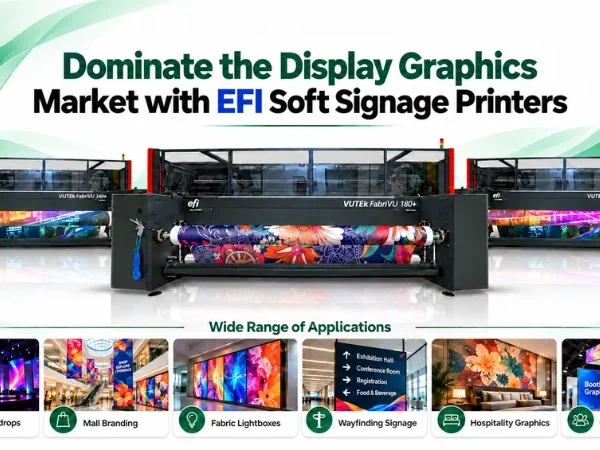
Dominate the Display Graphics Market with EFI Soft Signage Printers
Table of Contents Dominate the Display Graphics Market with EFI Soft Signage Printers EFI VUTEk FabriVU printers let your shop produce fabric display graphics, from
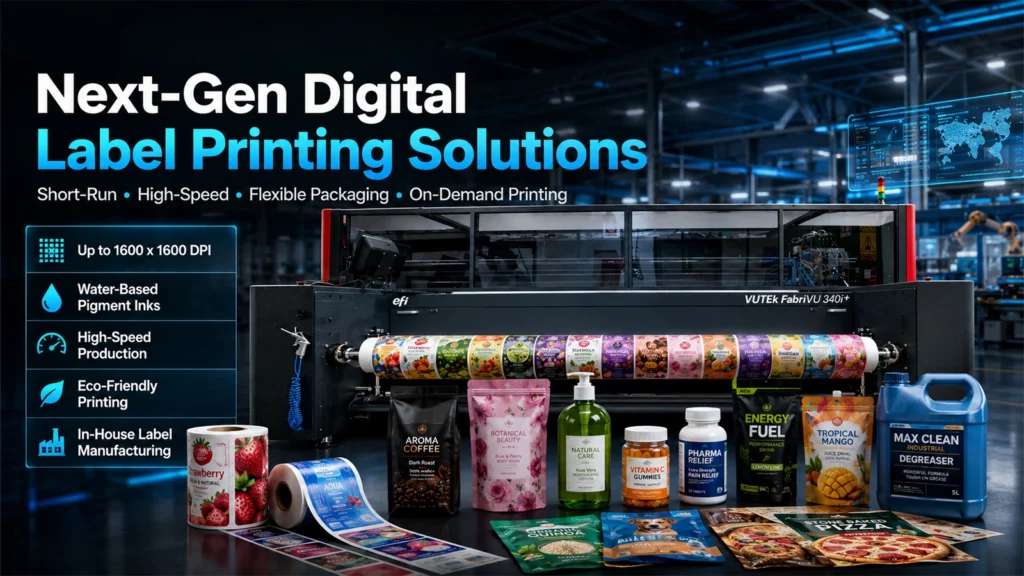
Arrow Digital‘s range of digital textile printers gives Indian textile manufacturers the ability to print photorealistic designs onto cotton, polyester, and blended fabrics — with no screens, no transfer paper, and no MOQ constraints.
A direct to fabric printer is a digital inkjet machine that applies ink directly onto textile substrates, bypassing transfer papers or screens entirely.
Unlike screen printing or rotary gravure, a direct to fabric printer uses inkjet heads to deposit reactive, pigment, sublimation, or disperse dye inks directly onto the fabric surface. A heat or steam fixation step then bonds the ink permanently into the fibre.
Term | Definition |
Direct to Fabric (DTF) Printer | A digital inkjet printer that applies ink directly onto fabric — cotton, polyester, silk, nylon, or blends — without screens, plates, or transfer media. |
Reactive Dye Ink | Water-based ink that bonds chemically with cellulosic fibres (cotton, rayon, linen). Produces vibrant, wash-fast colours. Requires a post-print steaming and washing step. |
Pigment Ink | A universal ink type compatible with most natural and synthetic fabrics. Requires no wet post-processing, making it the most operationally efficient option for on-demand production. |
Sublimation / Disperse Dye Ink | Used for synthetic fabrics (primarily polyester). Ink converts to gas under heat and bonds within the fibre structure, delivering exceptional colour vibrancy and wash durability. |
RIP Software | Raster Image Processing software that translates design files into precise inkjet printer commands, controlling colour profiles, ink limits, and resolution. |
Inline Fixation | A printer feature where heat/steam fixation occurs within the same machine pass as printing, eliminating the need for a separate fixation unit and reducing floorspace and production time. |
Direct to fabric printing converts a digital design file into a permanent, wash-fast print on fabric in five sequential steps.
Direct to fabric printing outperforms screen and rotary printing on setup time, MOQ, and design flexibility — while closing the gap on per-metre cost at mid-volume runs.
Attribute | Direct to Fabric (DTF) | Screen Printing | Rotary Printing |
Minimum Order Qty | 1 metre (no MOQ constraint) | Typically 500+ metres per design | Typically 5,000+ metres per design |
Setup Time | Minutes — no screens or plates | Hours — screen preparation required | Days — engraved rollers required |
Design Complexity | Unlimited colours, photorealistic | Limited by screen count (typically ≤8 colours) | Unlimited colours but high tooling cost |
Resolution | Up to 1,200–1,600 dpi | 60–100 lines per inch | Up to 120 lines per inch |
Ink Types | Reactive, pigment, sublimation, disperse | Plastisol, discharge, water-based | Reactive, pigment, vat |
Changeover Cost | Zero — files only | High — new screen per design change | Very high — new roller per design |
Sustainability | Water-based inks; low wastewater | Significant chemical wash waste | High water and chemical consumption |
Per-Metre Cost (Low Volume) | Cost-effective (no setup amortisation) | High (setup cost spread over few metres) | Very high (roller tooling amortisation) |
The five core advantages of direct to fabric printing are speed, sustainability, unlimited customisation, short-run economics, and exceptional print resolution.
Direct to fabric printers eliminate screen preparation, plate-making, and colour-matching approvals. A manufacturer can move from an approved design file to printed fabric within hours, not days. This is critical for fashion brands responding to trend cycles and for industrial textile producers managing short-notice customer orders.
Modern direct to fabric printers use water-based reactive or pigment inks, consuming significantly less water and generating less chemical effluent than conventional screen and rotary printing. For manufacturers in India operating under environmental compliance requirements, this is a measurable operational advantage.
DTF printers support variable data printing — each metre of fabric can carry a unique design without any additional setup cost. This enables seasonal collections, personalised products, regional variants, and limited-edition runs within a single production shift.
Because there are no setup costs — no screens, no plates, no rollers — the per-unit economics of DTF printing are favourable even at low volumes. Manufacturers and brands can produce small batches profitably, reducing overproduction and inventory risk.
Direct to fabric printers typically operate at 600 to 1,600 dpi, producing sharp edges, smooth gradients, and photorealistic imagery that screen printing cannot replicate. Advanced models such as the EFI VUTEk FabriVU 340i+ achieve resolutions up to 2,400 dpi with three-level greyscale for superior detail in fine-line and photographic designs
The three primary pain points in conventional textile printing — long lead times, high operational costs, and inconsistent quality — are directly addressed by direct to fabric technology.
Challenge | Traditional Printing Impact | How DTF Solves It |
Extended production lead times | Screen and rotary setup adds 3–10 days before a single metre is printed. | DTF eliminates setup entirely. Printing begins within minutes of design approval. |
High operational costs at low volume | Setup cost (screens, rollers) must be amortised — making small runs uneconomical. | No setup costs means each metre is priced on ink and fabric only, regardless of quantity. |
Inconsistent print quality | Screen registration drift and ink viscosity variation cause colour inconsistency run to run. | Digital inkjet produces identical output from first to last metre — no registration drift. |
Limited design flexibility | Each colour change requires a new screen or roller, constraining designers to low-colour patterns. | Full CMYK+ printing with no colour limit. Every design file prints as-is. |
High wastewater and chemical load | Screen printing generates significant wash waste from ink, emulsions, and cleaning chemicals. | Water-based DTF inks produce minimal effluent; some pigment-ink systems require no wet post-process. |

The EFI VUTEk FabriVU 340i+ is a 3.4-metre direct to fabric printer with integrated inline fixation, 2,400 dpi resolution, and up to 30% lower ink consumption versus comparable systems.
Available in India through Arrow Digital, the FabriVU 340i+ is engineered for high-throughput production across fashion, sportswear, soft signage, and home furnishing applications. Also see the EFI VUTEk FabriVU 180/340 for entry-level large-format fabric options.
Term | Definition |
Print Width | 3.4 metres (340 cm) — suited to wide soft signage and large-format fabric applications |
Resolution | Up to 2,400 dpi with three-level greyscale — delivers superior fine-line and photographic detail |
Inline Fixation | Integrated sublimation fixation eliminates a separate heat press — reduces floorspace and production steps |
Ink System | Water-based dispersed dye inks with higher dye concentration — up to 30% less ink consumption vs. competing systems |
Ink Recovery | Ink recovery system saves over 95% of ink typically lost during printhead purging |
Substrate Compatibility | Polyester and polyester-blend fabrics for fashion, sportswear, soft signage, flags, and display |
Software | Fiery XF RIP software with integrated colour management and workflow automation |
Direct to fabric printers serve seven primary market segments: apparel, home furnishings, soft signage, sportswear, custom merchandise, hospitality, and industrial textiles.

Designers and garment manufacturers use DTF printers in fashion and apparel printing to produce custom T-shirts, dresses, sarees, and high-fashion collections with no colour count restrictions, no minimum order quantities, and fast iteration between design rounds.
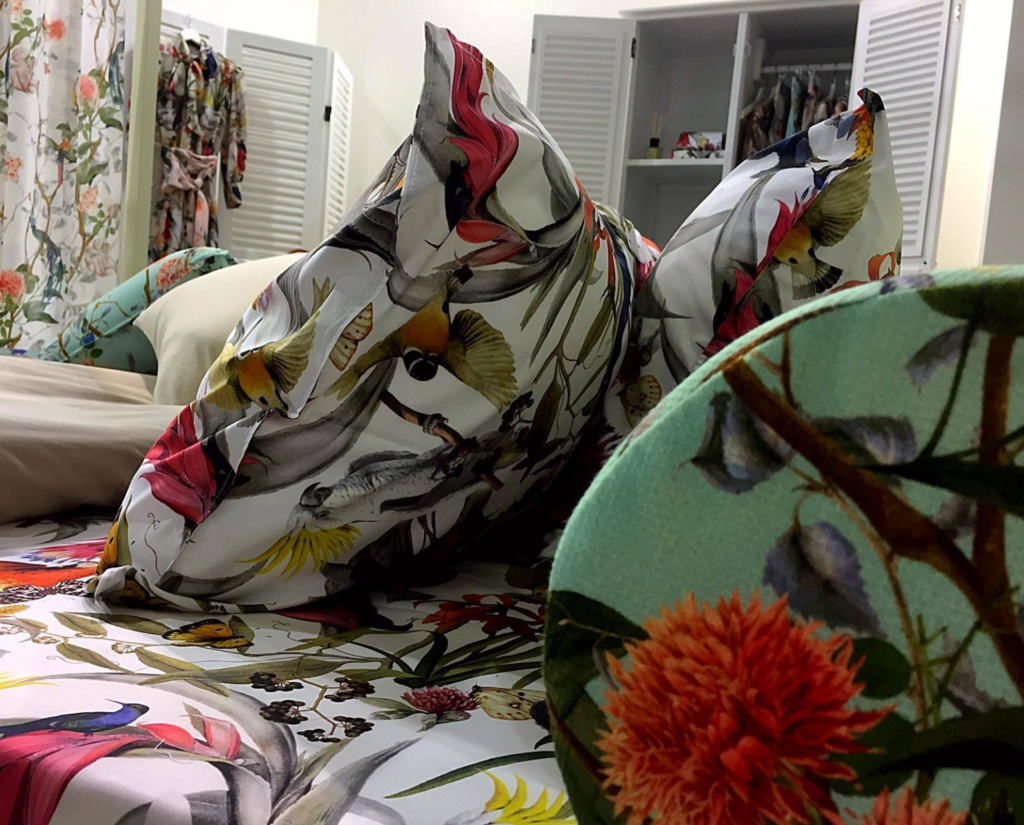
Curtains, upholstery, cushions, and bed linen benefit from the wash-fast, fade-resistant prints achievable with DTF technology. Home decor brands can produce seasonal and trend-responsive collections without committing to large screen printing runs.
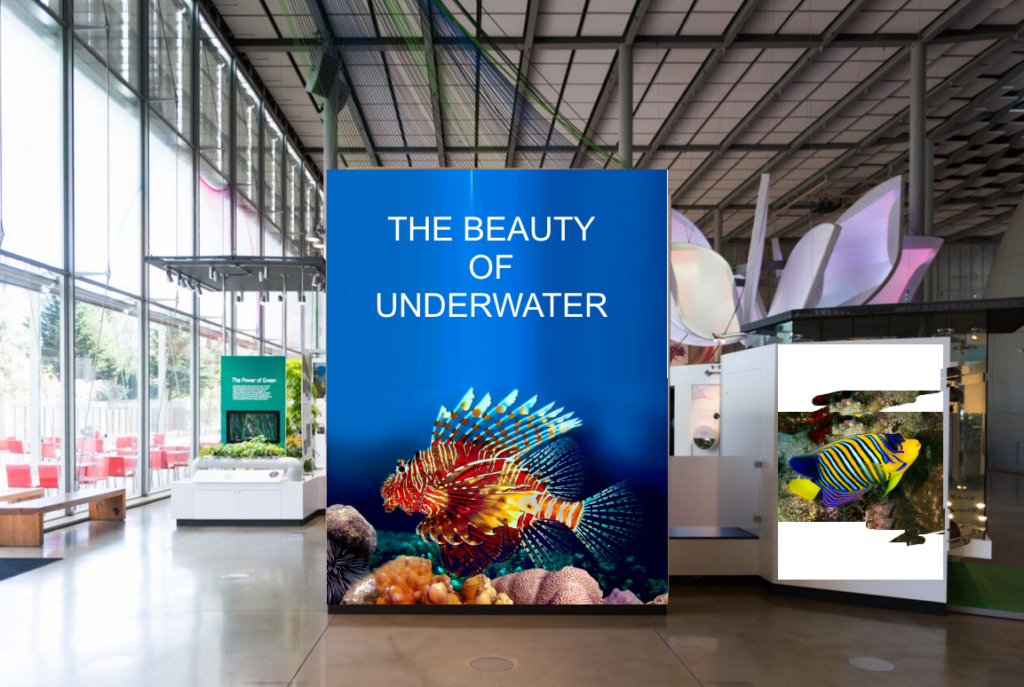
Trade show displays, retail banners, backlit fabric panels, and flags produced on direct to fabric printers are lightweight, portable, and produce significantly more vibrant colour than solvent-printed alternatives. In India, large format fabric soft signage is a fast-growing segment as brands move away from PVC flex — see how soft signage is taking over high-traffic exhibition spaces.

Performance fabrics — polyester, spandex, and technical blends — are compatible with sublimation-based DTF printing. Sportswear manufacturers benefit from high colour gamut, moisture-wicking surface compatibility, and elasticity retention in the finished print.
Scarves, tote bags, table runners, corporate uniform accessories, and branded merchandise can be produced profitably at small quantities using direct to fabric printers, making them viable for gifting campaigns, events, and limited-edition brand collateral.
Indian textile manufacturers are adopting direct to fabric printing to meet fast-fashion demand cycles, reduce inventory risk, and comply with tightening environmental discharge regulations.
India’s textile export industry — valued in excess of USD 36 billion annually — is under pressure from global buyers demanding shorter lead times, greater design variety, and verifiable sustainability credentials. Direct to fabric printing directly addresses each of these requirements.
Domestically, the shift away from PVC flex in urban markets is accelerating demand for fabric-based soft signage among exhibition organisers, retail chains, and event companies. For brands requiring a broader signage and display graphics capability, large format direct to fabric printing fills this gap with a product that is lighter, more reusable, and visually superior.
For SME garment manufacturers, the elimination of screen setup costs makes direct to fabric printing the first viable path to profitable short-run production — enabling them to serve boutique brands, D2C fashion labels, and custom gifting clients that screen printers cannot serve economically.
Evaluate a direct to fabric printer across eight parameters: print width, ink type, fixation system, resolution, substrate compatibility, software, running cost, and sustainability certifications.
Direct to fabric printing prints ink directly onto the fabric substrate. DTF transfer printing first prints onto a PET film, then heat-presses onto a garment. The two share an acronym but are not the same process.
Most direct to fabric printers support cotton, polyester, silk, nylon, rayon, and polyester-cotton blends. Ink type determines compatibility: reactive dyes for natural fibres, sublimation/disperse for synthetics, and pigment for mixed-fibre substrates. Pre-treatment may be required for some fabric types.
Production direct to fabric printers typically print at 600 to 1,200 dpi in standard throughput mode. High-end models such as the EFI VUTEk FabriVU 340i+ achieve up to 2,400 dpi with three-level greyscale, producing photorealistic detail and smooth gradients.
Yes. Because there are no screen or plate setup costs, direct to fabric printing is economical even at single-metre quantities. SME garment manufacturers, boutique fashion labels, and D2C brands can produce short-run collections profitably without MOQ constraints.
Entry-level production direct to fabric printers start from approximately INR 25–35 lakh depending on print width and ink system. High-throughput systems such as the EFI VUTEk FabriVU 340i+ carry a higher investment reflecting wider format, higher resolution, and integrated fixation. Contact Arrow Digital for pricing and ROI analysis.
Arrow Digital operates demonstration facilities across India. Contact the Arrow Digital team to arrange a live product demonstration of the EFI VUTEk FabriVU 340i+ and discuss your specific fabric, volume, and design requirements.
Table of Contents Dominate the Display Graphics Market with EFI Soft Signage Printers EFI VUTEk FabriVU printers let your shop produce fabric display graphics, from
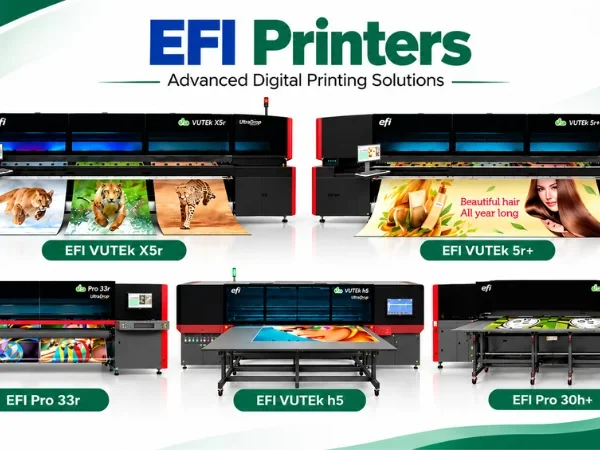
Table of Contents 7 Reasons to Buy EFI Printers for Your Print Business in India EFI printers let one print business serve signage, soft signage,
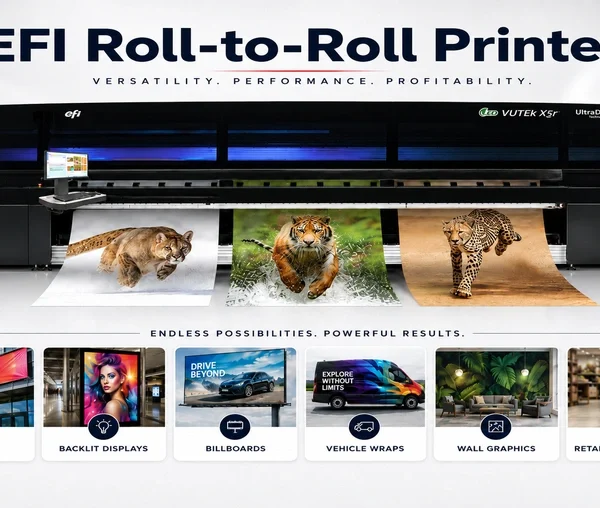
Table of Contents Why You Need EFI Roll-to-Roll Printers for Special Applications EFI VUTEk roll-to-roll printers become all-in-one production platforms with value-added accessories for finishing,
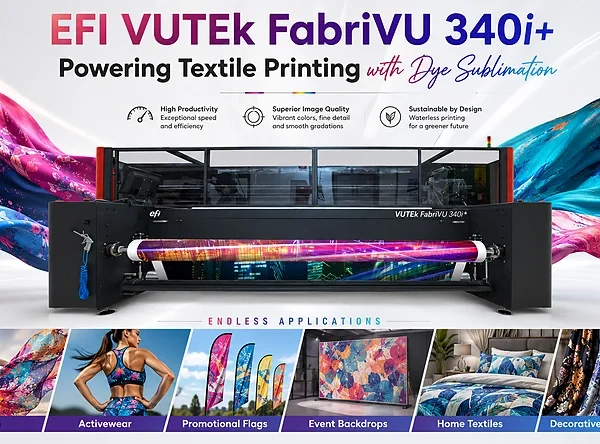
Table of Contents EFI VUTEk FabriVU 340i+ Dye Sublimation: A Great Choice for Textile Printing The EFI VUTEk FabriVU 340i+ prints and fixes fabric graphics
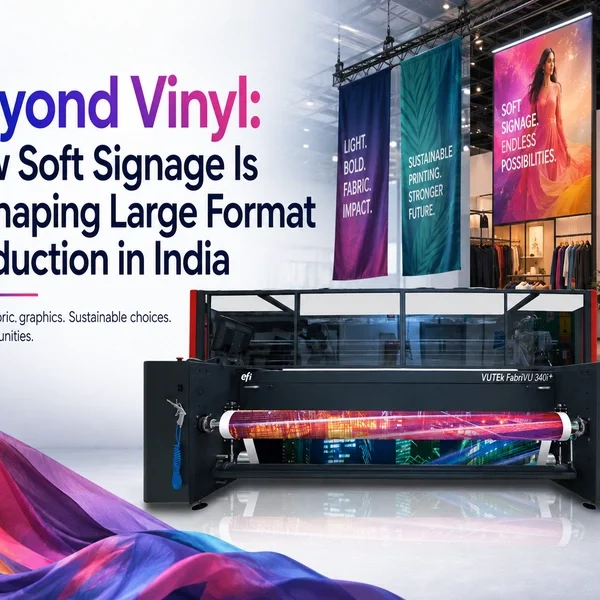
Table of Contents Beyond Vinyl: How Soft Signage Is Reshaping Large Format Production in India Print buyers across retail, events, and hospitality have been moving
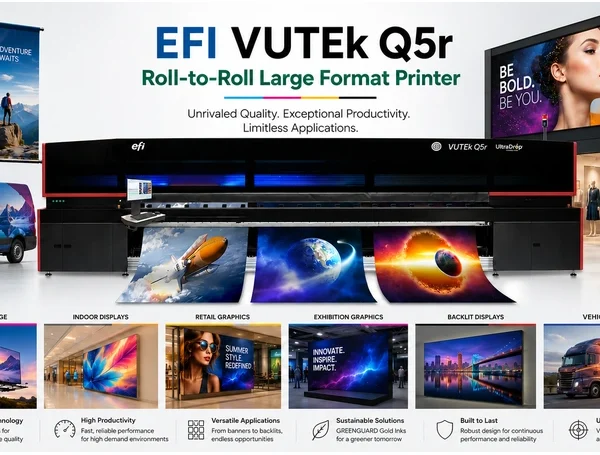
Table of Contents EFI VUTEk Q5r Roll-to-Roll Large Format Printer:Production Capabilities and Ink Options India’s large format print market is being shaped by one consistent