Digital Flatbed Cutters vs Traditional Finishing

Table of Contents

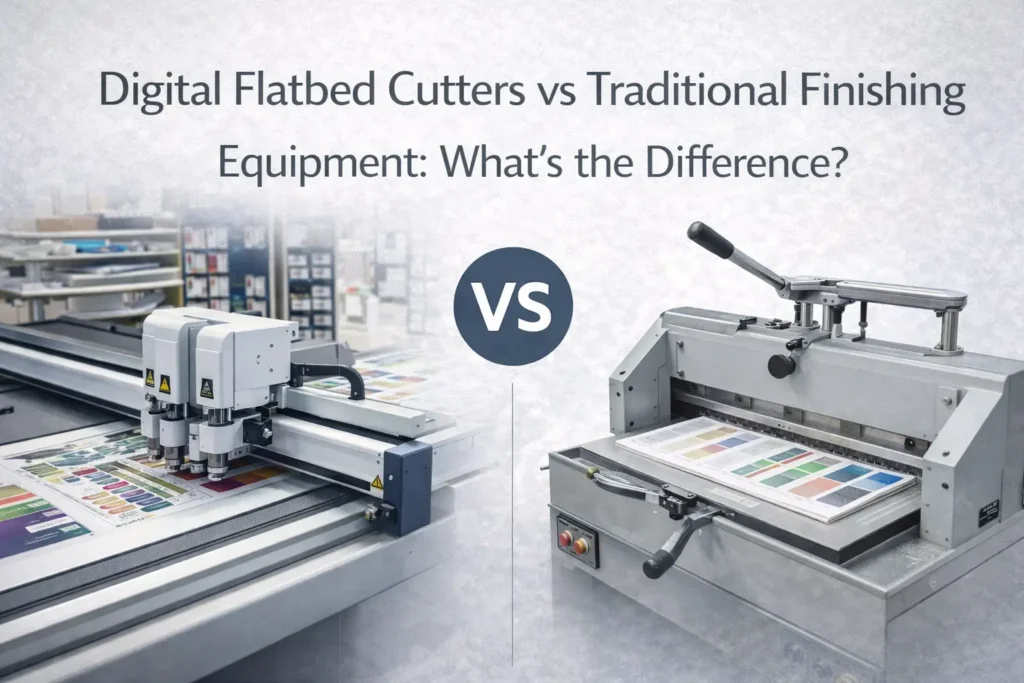
Digital Flatbed Cutters vs Traditional Finishing Equipment: What’s the Difference?

A digital flatbed cutter cuts, creases and routes from a digital file using interchangeable tools, so it needs no dies and suits short runs, prototypes and frequent design changes. Traditional die-based finishing costs more to set up, but it is faster once a long, repeat job is running.

As businesses seek efficient ways to produce prototypes, custom packaging, signage, and display materials, the choice between digital flatbed cutters and traditional finishing equipment becomes increasingly relevant. But what exactly sets these two apart? If you’re trying to decide which technology is right for your operation, this blog will guide you through the key differences, benefits, and use cases.

Understanding the Basics

Traditional Finishing Equipment refers to machines that generally rely on manual setups, dies, or mechanical components to perform tasks like cutting, creasing, folding, and laminating. These machines are often specialized for high-volume runs where the cost of setup is justified by scale.

Digital Flatbed Cutters, on the other hand, are automated, computer-controlled systems that use various interchangeable tools to cut, crease, and route a wide range of materials. Because every cut path comes from a digital file, there are no dies to make, store or replace.

1. Setup and Customization

Traditional Equipment:

  • Requires time-consuming setup, including die creation and machine calibration
  • High initial cost for dies and tooling
  • Not ideal for short runs or frequent design changes

Digital Flatbed Cutters:

  • Setup is digital and quick; no dies needed
  • Ideal for custom jobs, prototypes, and short runs
  • Allows rapid switching between materials and designs

Winner: Digital flatbed cutters — especially for dynamic, short-run environments

2. Versatility in Materials

Traditional Equipment:

  • Typically designed for specific materials (e.g., cardboard, paper)
  • Limited adaptability without hardware changes

Digital Flatbed Cutters:

  • Can handle a wide variety of substrates like foam board, vinyl, fabric, acrylic, aluminum, and more
  • Multi-tool systems allow for kiss cutting, routing, creasing, and V-cutting on the same platform

Winner: Digital flatbed cutters — unmatched flexibility across industries

3. Speed and Productivity

Traditional Equipment:

  • Faster for large-scale, repetitive jobs once set up
  • High throughput in mass production settings

Digital Flatbed Cutters:

  • Slightly slower for mass production but faster for small batches and variable data projects
  • Real-world speed depends on material thickness, the tool in use and the complexity of the cut path, so compare machines on your own substrates rather than headline maximums

Winner: Depends on job type — traditional for high-volume consistency, digital for agile production

4. Precision and Quality

Traditional Equipment:

  • Consistent results once die is perfected
  • Precision may degrade over time with mechanical wear

Digital Flatbed Cutters:

  • Precision up to ≤ 0.05 mm, thanks to CNC control and CCD registration systems
  • Maintains consistent accuracy across materials and complex designs

Winner: Digital flatbed cutters — better suited for modern design complexity and quality assurance

5. Operational Footprint and Cost

Traditional Equipment:

  • Larger physical footprint
  • Requires storage for dies and parts
  • High operational costs for maintenance and die replacement

Digital Flatbed Cutters:

  • Compact and modular designs
  • Reduced storage needs
  • Lower operating costs due to digital tooling and fewer consumables

Winner: Digital flatbed cutters — cost-effective and space-saving

6. Workforce and Training

Traditional Equipment:

  • Requires skilled operators for setup and troubleshooting
  • Often labor-intensive

Digital Flatbed Cutters:

  • User-friendly interfaces and automation reduce training time
  • Remote diagnostics and software updates streamline operations

Winner: Digital flatbed cutters — more accessible to modern workforces

7. Environmental Impact

Traditional Equipment:

  • Die production generates waste
  • Limited optimization for material usage

Digital Flatbed Cutters:

  • Digital designs minimize material waste
  • Eco-friendly features like automated nesting and optimized tool paths

Winner: Digital flatbed cutters — better aligned with sustainability goals

Key Takeaways

Feature

Traditional Finishing

Digital Flatbed Cutters

Setup Time

Long & manual

Quick & digital

Material Flexibility

Limited

High

Speed for Short Runs

Inefficient

Highly efficient

Design Adaptability

Low

High

Operator Skill Required

High

Low to Medium

Waste Generation

Higher

Lower

Cost Efficiency

High for long runs

High for short/custom runs

Which Cutting Tool to Use for Each Material

Digital flatbed cutters take interchangeable tools, and each tool suits a different class of material:

  • Oscillating knife: PVC, cardboard, corrugated board and foam board. Use it for signage, POP displays and packaging prototypes.
  • Kiss cut tool: Vinyl, sticker sheets and other materials on a liner. It cuts the top layer only, so labels stay on the backing ready to apply. For roll-fed labels, a blade finisher such as the Arrow EZCut 330R does this inline.
  • V-cut tool: Foam board and sandwich board. Its 45° bevels give clean folds for standees and 3D displays.
  • Rotary tool: Polyester, cotton and other textiles. The rolling blade cuts without fraying.
  • Milling tool: Acrylic, aluminium and ACP. It routes hard materials a blade would chip, and needs dust extraction while running.

Table: Application-to-Tool Matching

ApplicationMaterialRecommended ToolWhy
Label productionVinyl, sticker sheetsKiss cut toolCuts the top layer only and keeps the liner intact
POP displaysCorrugated boardOscillating knifeCuts medium-density rigid board cleanly
Textile cuttingPolyester, cottonRotary toolRolling cut prevents fraying
Exhibition standeesFoam boardV-cut tool45° bevels give clean folds for 3D builds
Outdoor signageAcrylic, ACPMilling toolRoutes hard, dense substrates without chipping

Conclusion

The choice between traditional finishing equipment and digital flatbed cutters boils down to your specific production needs. If you’re dealing with large-scale, repetitive jobs and already own the tooling, traditional methods may still have a place. However, for modern businesses requiring agility, customization, and versatility, digital flatbed cutters provide a smart, future-ready solution.

In a market that demands both speed and creativity, the flexibility of digital solutions is hard to beat. Whether you’re running prototypes, one-off designs, or short batches across diverse materials, going digital offers the competitive edge you need to stay ahead.

Get In Touch with us to get a Live Demo

ARROW × LOUPE INDIA 2026

LOUPE INDIA 2026 comes to Delhi NCR.

Discover new ways to print and finish labels with Arrow Digital.

Explore aqueous pigment printing, flexible short runs and precision die-cutting.

DELHI NCR EDITION
29

OCT – 01 NOV

2026 · THURSDAY–SUNDAY

HALL 10 · BOOTH G-10

India Expo Centre & Mart

Greater Noida, Delhi NCR.