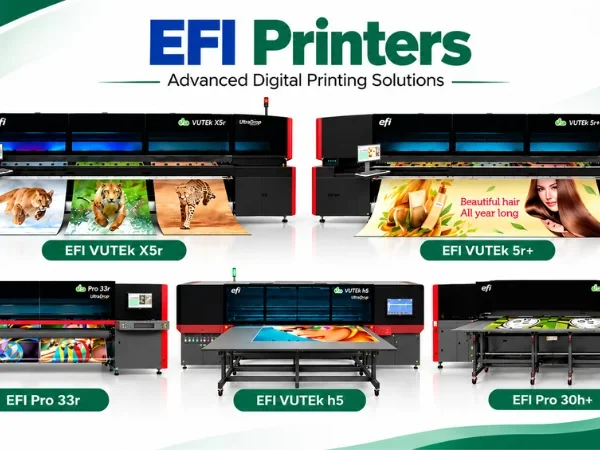
7 Reasons to Buy EFI Printers for Your Print Business in India
Table of Contents 7 Reasons to Buy EFI Printers for Your Print Business in India EFI printers let one print business serve signage, soft signage,

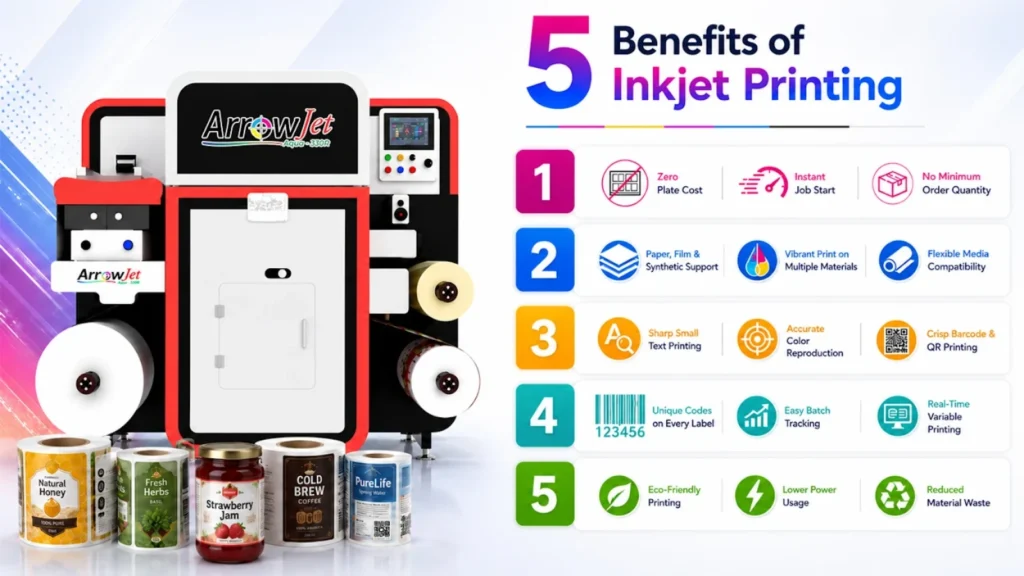
Digital inkjet label printing eliminates plates, reduces minimum quantities, and lowers cost per label — especially for short and medium runs.
Commercial inkjet label printing systems print directly from digital files onto paper, film, and flexible substrates — no printing plates required. This makes them the most cost-efficient technology for label converters producing short runs, versioned labels, or on-demand production. In India, label manufacturers investing in digital inkjet equipment are able to serve FMCG, pharmaceutical, food and beverage, and specialty chemical clients without committing to high minimum orders or long turnaround times.
Inkjet printing is a non-contact digital printing process that propels microscopic droplets of ink through a print head directly onto a substrate. There are no plates, screens, or cylinders — every job prints straight from a digital file. This enables variable data printing (unique barcodes, QR codes, sequential numbering) as a native capability, not an add-on.
Term | Definition |
Digital inkjet printing | A plateless printing process using inkjet heads to deposit ink droplets on substrates. Files print directly from pre-press software, enabling instant job changeovers. |
UV inkjet | An inkjet system using ultraviolet-curable inks. UV inks cure instantly under UV lamps, delivering superior abrasion resistance and substrate compatibility on non-porous films. |
Water-based inkjet | An inkjet system using aqueous inks. Preferred for paper-based labels, eco-certified applications, and food-adjacent packaging where solvent emissions are a concern. |
Variable data printing (VDP) | The ability to print unique information (serial numbers, QR codes, personalised text) on every label without slowing the press or changing setup. |
Print resolution (dpi) | Dots per inch — the measure of output sharpness. Commercial label inkjet systems typically run at 600–1,200 dpi, sufficient for fine barcodes and regulatory text. |
Digital inkjet label printing systems offer five advantages that are particularly significant for label converters, brand owners, and in-house print operations in India.
No plate cost means inkjet printing is cost-effective from the very first label.
Conventional flexographic and offset label printing requires a separate plate per colour, each carrying an associated plate-making cost. Inkjet printing has zero plate cost — every job prints directly from a digital file at the same per-unit cost, regardless of run length.
This makes inkjet the lowest total cost option for runs below 10,000 labels, versioned SKUs, seasonal labels, and pilot batches where minimum quantities would otherwise make short-run flexo uneconomical.
Modern inkjet label systems print on paper, PP, PE, BOPP, PET, foil, and synthetic films.
UV inkjet systems are compatible with non-absorbent substrates that water-based or thermal printing cannot handle, including metallised films, transparent BOPP, and pressure-sensitive synthetics. This expands the range of label products a converter can offer without switching press technology.
ArrowJet UV label printers, for example, support substrates from 25 micron PET to 250 gsm board, covering the majority of primary and secondary label applications across food, beverage, personal care, and pharmaceutical categories.
Commercial inkjet label systems produce 600–1,200 dpi output, meeting regulatory legibility requirements.
Fine barcodes, 2D QR codes, small regulatory text (4pt and above), and detailed brand artwork all reproduce accurately at commercial inkjet resolutions. This matters particularly for pharmaceutical labels, where FSSAI, FDA, and drug scheduling information must be legible at inspection.
Unlike desktop inkjet printers, commercial label inkjet systems maintain consistent dot placement at rated production speeds — typically 30–80 linear metres per minute — without banding, streaking, or registration errors.
Every label can carry unique barcodes, QR codes, or serialised text without slowing the press.
Variable data printing is a native capability of inkjet — the system draws directly from a connected database for each label, enabling full serialisation, lot-based coding, personalised packaging, and anti-counterfeit QR codes in a single pass. No additional equipment, no sticker application, and no secondary process.
For pharmaceutical track-and-trace compliance, FMCG promotions, and government e-way bill requirements, this makes inkjet the only press technology that handles variability at speed and scale without operator intervention between runs.
Inkjet printing consumes significantly less energy than heat-intensive printing technologies.
UV inkjet systems cure ink with focused UV LEDs rather than heat lamps or ovens, reducing energy draw per linear metre compared to conventional dryer-equipped presses. There is no waste from plate making, no chemical development process, and no substrate spoilage during make-ready — inkjet produces saleable output from the first label of every job.
For label converters benchmarking sustainability metrics or responding to brand owner ESG requirements, digital inkjet reduces both energy intensity and material waste per job compared to conventional print processes.
The table below compares digital inkjet label printing against the two most common alternative technologies for label converters evaluating a new press investment in India.
Criterion | Digital Inkjet | Flexographic | Thermal Transfer |
Setup / Make-ready | No plates — zero setup cost | Plate making adds fixed cost per job | Ribbon cost per linear metre |
Minimum Order Quantity | From 1 label | 10,000+ labels typical | 500+ labels typical |
Colour capability | Full CMYK + White + Specialty | Spot colours only (per plate) | Limited; monochrome common |
Variable data | Native — barcodes, QR, serialise | Not supported | Limited via software |
Substrate range | Paper, PP, PE, BOPP, foil, PET | Fixed — substrate tied to ink system | Polyester, resin-coated only |
Turnaround | Same day to 48 hours | 5–10 days (plate production) | 1–3 days |
Ink type options | UV, water-based, pigment | UV, water-based, solvent | Wax, resin, wax-resin ribbons |
Digital inkjet label printing equipment delivers the highest return on investment in production environments where any of the following conditions are present: frequent job changeovers, short-to-medium run lengths, variable data requirements, or premium substrate compatibility.
Industry | Key inkjet advantage for this vertical |
Food & Beverage | Short runs per SKU, seasonal variants, water-based ink for food-adjacent substrates, FSSAI-compliant text legibility at regulated font sizes. |
Pharmaceutical | Serialisation and track-and-trace compliance, small-text legibility, lot-level variable data without offline coding. |
Personal Care & Cosmetics | High-resolution brand artwork on transparent and metallic films, multiple SKU variants from a single press run. |
Specialty Chemicals | Robust UV-cured inks compatible with GHS labelling requirements, abrasion and chemical-resistant labels on BOPP and polyester. |
Wine, Spirits & Gourmet | Ultra-short runs, premium metallic substrates, numbered limited-edition serialisation. |
Nutraceuticals & Health | Regulatory text at small point sizes, QR codes for product authentication, rapid changeovers between formulation variants. |
The questions below address the most common considerations for label converters and brand owners evaluating digital inkjet label printing equipment in India.
There is no minimum order quantity (MOQ) for digital inkjet printing. Inkjet systems print from 1 label up to full production volumes without plate changes or make-ready adjustments. This makes inkjet the only technology where 50-label and 50,000-label runs cost the same per-unit setup.
Yes. UV inkjet label printing systems support transparent BOPP, clear PET, metallised films, and foil substrates. UV inks cure and adhere to non-porous surfaces that water-based inks cannot. White ink as a base layer is available on ArrowJet UV systems to create opacity on clear and metallic films.
Commercial inkjet label systems typically run at 30–80 linear metres per minute depending on resolution mode. At standard production quality (600 dpi), ArrowJet series printers operate at up to 60 metres per minute — faster than thermal transfer and comparable to low-volume flexo runs.
Yes. Commercial inkjet label systems produce text at 4pt and above at 600+ dpi — sufficient for CDSCO and FSSAI regulatory text legibility requirements. Serialisation and lot coding are handled in-line without secondary offline coding equipment. Consult Arrow Digital’s technical team for ink suitability with specific pharmaceutical substrates.
Commercial label inkjet systems use UV-curable inks, water-based pigment inks, or water-based dye inks depending on the press model and substrate target. UV inks (used in ArrowJet UV series) deliver the widest substrate compatibility and the highest abrasion resistance. Water-based inks are preferred for paper labels and eco-certified applications.
For runs below approximately 10,000 labels, digital inkjet printing is lower total cost than flexographic printing because it eliminates plate costs and make-ready waste. Above 50,000 labels per job, flexo becomes more cost-competitive on per-unit ink cost. The crossover point depends on colour count, substrate, and job repeat frequency — Arrow Digital’s cost-per-label calculator can model this for your production mix.
Digital inkjet label printing is the lowest total cost, most flexible, and most versatile label production technology for short and medium runs in India.
Label converters and brand owners evaluating a new press investment should consider digital inkjet when their production mix includes any of the following: runs below 10,000 labels, multiple versioned SKUs, variable data or serialisation requirements, or premium substrates.
ArrowJet digital label printing systems from Arrow Digital India are purpose-built for commercial label production — covering UV inkjet and water-based inkjet configurations across a range of web widths and production speeds. Arrow Digital operates application labs and demo centres across Ahmedabad, Mumbai, Delhi, Bengaluru, Kolkata, and Pune.
Table of Contents 7 Reasons to Buy EFI Printers for Your Print Business in India EFI printers let one print business serve signage, soft signage,
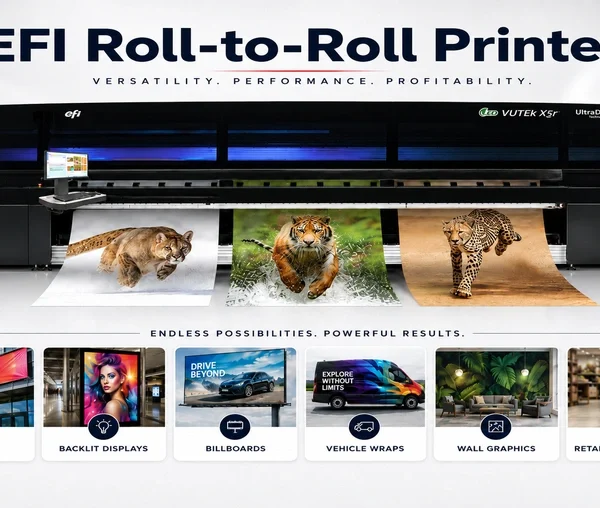
Table of Contents Why You Need EFI Roll-to-Roll Printers for Special Applications EFI VUTEk roll-to-roll printers become all-in-one production platforms with value-added accessories for finishing,
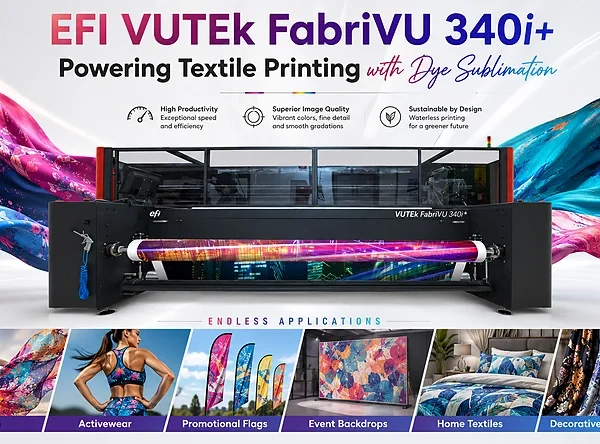
Table of Contents EFI VUTEk FabriVU 340i+ Dye Sublimation: A Great Choice for Textile Printing The EFI VUTEk FabriVU 340i+ prints and fixes fabric graphics
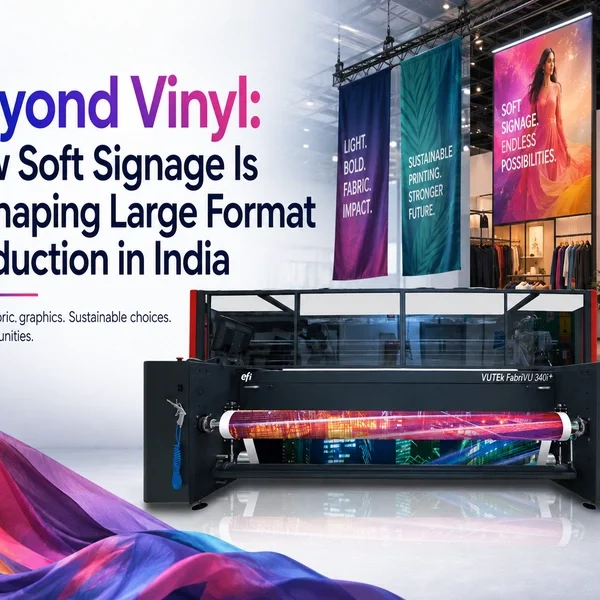
Table of Contents Beyond Vinyl: How Soft Signage Is Reshaping Large Format Production in India Print buyers across retail, events, and hospitality have been moving