From Trade Shows to Airports: How Soft Signage Dominates High-Traffic Spaces
Table of Contents From Trade Shows to Airports: How Soft Signage Dominates High-Traffic Spaces Soft signage is a fabric-based large format printing category used by

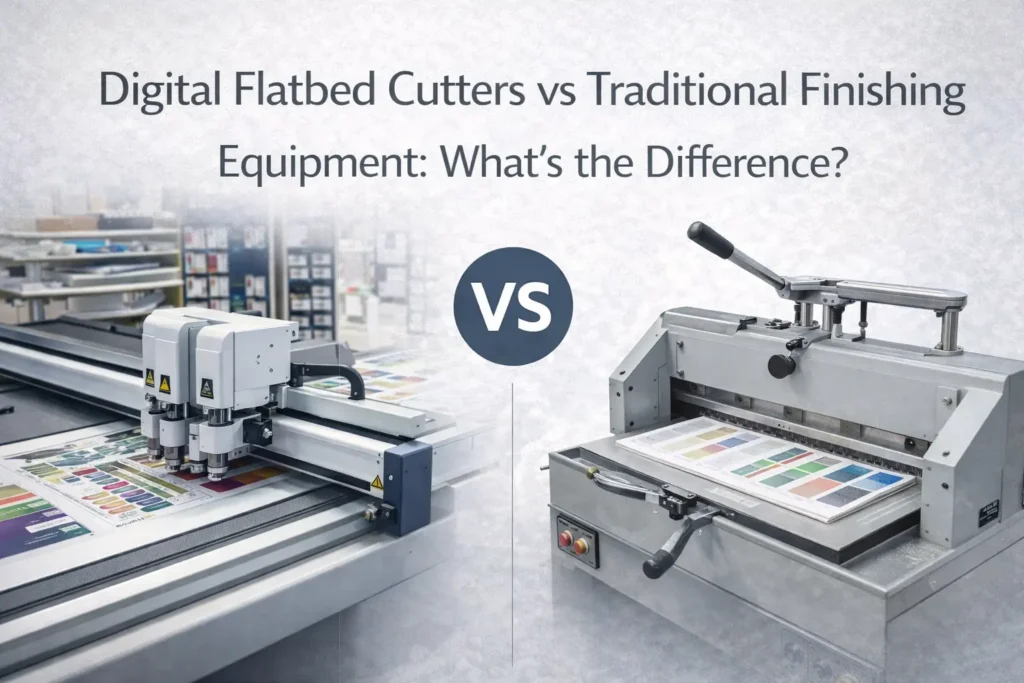
As businesses seek efficient ways to produce prototypes, custom packaging, signage, and display materials, the choice between digital flatbed cutters and traditional finishing equipment becomes increasingly relevant. But what exactly sets these two apart? If you’re trying to decide which technology is right for your operation, this blog will guide you through the key differences, benefits, and use cases.
Traditional Finishing Equipment refers to machines that generally rely on manual setups, dies, or mechanical components to perform tasks like cutting, creasing, folding, and laminating. These machines are often specialized for high-volume runs where the cost of setup is justified by scale.
Digital Flatbed Cutters, on the other hand, are automated, computer-controlled systems that use various interchangeable tools to cut, crease, and route a wide range of materials. Systems like the ArrowCut Nexa 510 are examples of modern digital finishing solutions.

Winner: Digital flatbed cutters — especially for dynamic, short-run environments
Winner: Digital flatbed cutters — unmatched flexibility across industries
Winner: Depends on job type — traditional for high-volume consistency, digital for agile production
Winner: Digital flatbed cutters — better suited for modern design complexity and quality assurance
Winner: Digital flatbed cutters — cost-effective and space-saving
Winner: Digital flatbed cutters — more accessible to modern workforces
Winner: Digital flatbed cutters — better aligned with sustainability goals
Feature | Traditional Finishing | Digital Flatbed Cutters |
Setup Time | Long & manual | Quick & digital |
Material Flexibility | Limited | High |
Speed for Short Runs | Inefficient | Highly efficient |
Design Adaptability | Low | High |
Operator Skill Required | High | Low to Medium |
Waste Generation | Higher | Lower |
Cost Efficiency | High for long runs | High for short/custom runs |
The choice between traditional finishing equipment and digital flatbed cutters boils down to your specific production needs. If you’re dealing with large-scale, repetitive jobs and already own the tooling, traditional methods may still have a place. However, for modern businesses requiring agility, customization, and versatility, digital flatbed cutters like the ArrowCut Nexa 510 provide a smart, future-ready solution.
In a market that demands both speed and creativity, the flexibility of digital solutions is hard to beat. Whether you’re running prototypes, one-off designs, or short batches across diverse materials, going digital offers the competitive edge you need to stay ahead.

Table of Contents From Trade Shows to Airports: How Soft Signage Dominates High-Traffic Spaces Soft signage is a fabric-based large format printing category used by

Table of Contents Backlit and Blockout Printing with EFI VUTEk Roll-to-Roll Large Format Printers: A Production Guide for Indian PSPs Backlit and blockout printing are

Table of Contents Dye-Sublimation vs UV Printing for Soft Signage Dye-sublimation bonds colour into polyester fabric; UV printing cures ink on the surface. Both produce

Table of Contents Custom Wallpaper Printing: How It Works & Where to Use It Transforming Walls into Statements Custom wallpaper printing lets businesses and homeowners

Table of Contents Arrow Greenboard: The Eco-Friendly, PVC-Free Substrate for Large Format UV Printing Arrow Greenboard is a 100% biodegradable, PVC-free printing substrate compatible with

Table of Contents Ink Composition & Sustainability Benefits of Water-Based Inks Water-based inks use water as the carrier fluid — delivering vibrant, durable label prints