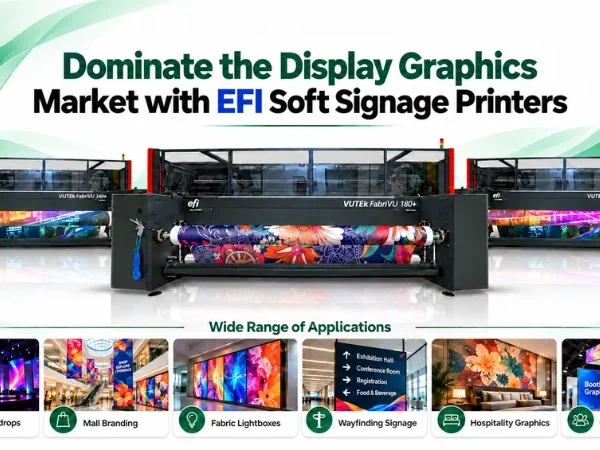
Dominate the Display Graphics Market with EFI Soft Signage Printers
Table of Contents Dominate the Display Graphics Market with EFI Soft Signage Printers EFI VUTEk FabriVU printers let your shop produce fabric display graphics, from


UV large format printers cure ink instantly with UV light — delivering faster throughput, broader substrate range, and lower cost per m² than latex alternatives.
UV printing uses ultraviolet light to cure ink on contact — no heat, no wait. Ink bonds to the substrate in milliseconds.
UV (ultraviolet) large format printing is a process in which UV-curable inks are deposited onto a substrate and instantly hardened by ultraviolet lamps mounted on the print head carriage. Because the ink solidifies on contact, UV printing requires no drying time and generates minimal volatile organic compounds (VOCs).
UV large format printers in India are available in three configurations: roll-to-roll (flexible substrates), flatbed (rigid substrates), and hybrid (both). Each configuration uses the same UV cure mechanism, making the technology versatile across signage, labels, packaging, vehicle graphics, and industrial surfaces.
Key Terms: UV Printing
Term | Definition |
UV-curable ink | Ink that polymerises and hardens when exposed to ultraviolet light; no heat or solvent evaporation required. |
UV lamp / LED | Light source (mercury UV lamp or UV LED array) mounted on the print carriage that cures ink as the head passes. |
Hybrid UV printer | A large format printer that accepts both rigid sheets (flatbed mode) and flexible roll media in a single machine. |
Roll-to-roll UV | A UV printer configuration designed for continuous flexible substrates; ideal for banners, vinyl, and textile rolls. |
Latex printing uses water-based inks containing latex polymers that cure by heat (60–80°C), limiting substrate choices to heat-tolerant flexible media.
In latex large format printing, the print head deposits water-based inks onto the substrate. The printer then passes the media through a heated drying zone (typically 60–80°C) to evaporate water and fuse the latex polymers into a film. Because the cure process requires sustained heat, latex printers are limited to flexible, heat-tolerant substrates such as PVC banner, self-adhesive vinyl, and some textile types.
Latex printing does not require a separate lamination step for outdoor durability, which simplifies post-production for standard signage applications. However, latex printers cannot print on rigid substrates (glass, metal, acrylic) and do not support hybrid or flatbed configurations.
UV and latex printers differ across five critical dimensions: substrate range, throughput, durability, configuration options, and total cost of ownership.
Factor | UV Large Format Printing | Latex Large Format Printing |
Ink Curing Method | UV light — instant cure (milliseconds) | Heat-based — 60–80°C drying zone |
Substrate Range | Rigid + flexible: glass, metal, acrylic, PVC, fabric, wood, MDF | Flexible only: PVC banner, vinyl, heat-tolerant textiles |
Max Print Speed | Up to 672 m²/hr (EFI VUTEk superwide roll-to-roll) | Typically 50–150 m²/hr |
Flatbed Configuration | Available — rigid substrates up to several cm thick | Not available |
Hybrid Configuration | Available — one machine for rigid and flexible | Not available |
Soft Signage Option | Available with UV large format printers | Not available |
Outdoor Durability | High UV and scratch resistance; typically does not require lamination | Good UV resistance; lamination may be needed for heavy abrasion |
Cost Per m² | Lower at volume — high throughput reduces unit cost | Higher — slower throughput and heat energy costs |
VOC Emissions | Minimal — no solvent evaporation | Low — water-based, but heat process required |
Substrate Damage Risk | None — no heat applied to substrate | Moderate — heat can warp heat-sensitive materials |
For print businesses evaluating large format equipment, UV printers offer measurable advantages across durability, versatility, speed, cost, and configuration breadth.
UV-cured inks form a hard polymer bond with the substrate surface. This results in high resistance to scratching, fading, and moisture — without a lamination step. Latex inks cure into a softer film that is more susceptible to smudging before full heat cure and to scratching in high-contact applications.
UV printers deposit ink on glass, metal, acrylic, PVC, fabric, wood, MDF, corrugated board, and more — both rigid and flexible. Latex printers are restricted to flexible, heat-tolerant media. For a large format print business seeking to serve diverse substrate markets, UV equipment removes a critical production bottleneck.
EFI VUTEk superwide roll-to-roll UV printers reach up to 672 m²/hr — among the highest rated throughput speeds in the large format market. Latex printers typically achieve 50–150 m²/hr. Higher throughput directly reduces cost per m² and increases job capacity per shift.
UV large format technology supports roll-to-roll, flatbed, hybrid, and soft signage printer configurations — four distinct revenue streams from a single technology platform. Latex printing is available only in roll-to-roll format, limiting the applications a print business can serve with a latex investment.
UV printers operate without a heat zone, reducing energy consumption compared to heated latex systems. Higher throughput lowers cost per m² at volume. Combined with a broader substrate range that enables premium-margin applications (rigid printing, industrial surfaces), UV large format equipment typically delivers a stronger ROI for Indian print businesses.
Arrow Digital distributes EFI VUTEk UV large format printers across India — covering roll-to-roll, hybrid, flatbed, and soft signage configurations.
Configuration | Recommended Application | Key Spec |
EFI VUTEk Superwide Roll-to-Roll | Banners, backlit, POS displays, soft signage | Up to 672 m²/hr |
EFI VUTEk Hybrid UV | Mixed rigid and flexible jobs in a single workflow | Up to 198 ft²/hr |
EFI VUTEk Flatbed UV | Glass, acrylic, MDF, metal — rigid substrate printing | Direct-to-rigid, variable depth |
EFI VUTEk Soft Signage UV | Fabric displays, exhibition graphics, retail textile | Dedicated textile UV — no latex equivalent |
Arrow Digital operates service and demonstration centres across Ahmedabad, Bengaluru, Delhi, Indore, Kolkata, Mumbai, Pune, and Surat. Live demonstrations of EFI VUTEk UV printers are available at all branches.
Yes. UV hybrid large format printers support both rigid substrates (glass, metal, acrylic, MDF) and flexible roll media (PVC, vinyl, fabric) in a single machine. Latex printers are restricted to flexible, heat-tolerant media only.
Yes. UV-cured inks provide high resistance to UV radiation, moisture, and physical abrasion — making them well suited for outdoor signage, vehicle graphics, building wraps, and hoardings in Indian climate conditions.
UV large format printers offer broader substrate compatibility, higher throughput (up to 672 m²/hr for EFI VUTEk superwide models), lower cost per m² at volume, and four configuration options (roll-to-roll, flatbed, hybrid, soft signage) versus one for latex. For most large format print businesses in India, UV equipment delivers higher ROI.
UV printers require periodic UV lamp or UV LED inspection, print head maintenance, and ink system checks — similar to other large format inkjet technologies. EFI VUTEk printers distributed by Arrow Digital are supported by service engineers across eight branches in India.
Latex printing remains suitable for businesses focused exclusively on flexible PVC and vinyl substrates with moderate volume requirements. However, UV large format printing has become the dominant technology in the Indian market due to its speed, substrate versatility, and configuration breadth.
Table of Contents Dominate the Display Graphics Market with EFI Soft Signage Printers EFI VUTEk FabriVU printers let your shop produce fabric display graphics, from
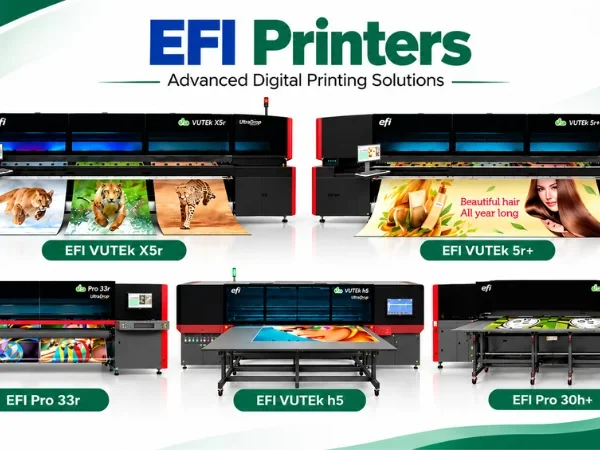
Table of Contents 7 Reasons to Buy EFI Printers for Your Print Business in India EFI printers let one print business serve signage, soft signage,
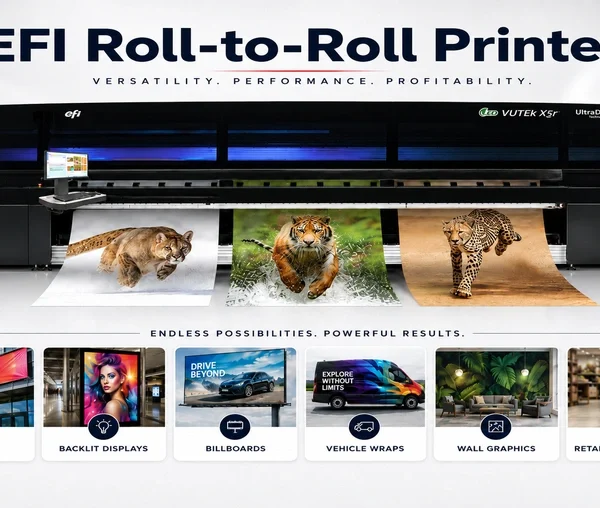
Table of Contents Why You Need EFI Roll-to-Roll Printers for Special Applications EFI VUTEk roll-to-roll printers become all-in-one production platforms with value-added accessories for finishing,
We Are India’s Leading Brand In Bringing Latest, Innovative Printing and Finishing Solutions
Discover new ways to print and finish labels with Arrow Digital.
Explore aqueous pigment printing, flexible short runs and precision die-cutting.
2026 · THURSDAY–SUNDAY
Greater Noida, Delhi NCR.