Table of Contents

Formech Thermoforming Machines in India Desktop to Large Format — Complete Buyer Guide

What Is Thermoforming (Vacuum Forming)?

Thermoforming heats a plastic sheet until pliable, drapes it over a mould, then uses vacuum pressure to form and eject a shaped part.

The process — also called vacuum forming — has been in industrial use since the 1930s and remains one of the most cost-effective methods for shaping thermoplastic materials at scale.

How the Process Works — Step by Step

Step

Stage

What Happens

1

Heat

A flat thermoplastic sheet is clamped and heated until it becomes pliable (typically 120–200°C depending on material).

2

Drape

The softened sheet is lowered over or raised onto a mould (tool).

3

Vacuum

Air is evacuated between the sheet and mould, pulling the plastic into the mould contours.

4

Cool & Eject

The formed sheet cools, hardens, and is ejected from the mould.

5

Trim

Excess plastic is trimmed away using a cutter or router to produce the finished part.

One key advantage is tooling speed: a vacuum forming mould can be produced in hours using 3D-printed or CNC-machined tools, compared to weeks for injection moulding tooling.

Thermoforming vs. 3D Printing vs. Injection Moulding

Thermoforming offers a lower tooling cost and faster turnaround than injection moulding, with better surface finish and higher output than 3D printing.

Factor

Thermoforming

3D Printing

Injection Moulding

Tooling Cost

Low (3D-printable moulds possible)

None (toolless)

Very high (steel or aluminium tooling)

Tooling Lead Time

1–3 days

None

4–12 weeks

Part Size

Up to 2440 × 1220 mm (Formech)

Limited by print bed

Limited by mould size

Surface Finish

Smooth, printable

Layered/textured

High gloss (tool-dependent)

Minimum Quantity

Low (1+ units)

Low (1 unit)

High (1,000+ units typical)

Material Options

ABS, PETG, PVC, HIPS, Acrylic, PC

PLA, ABS, Resin, Nylon

Wide (tool-specific)

Digitally Printable Surface

Yes (with TF-compatible inks)

Limited

Yes (post-moulding)

Note: Thermoforming is optimal when tooling cost, delivery time, and the ability to combine print-and-form in a single workflow are key decision factors.

Industries and Applications of Vacuum Forming

Vacuum-formed parts are used across packaging, retail display, aerospace, automotive, set design, and point-of-sale industries worldwide.

Industry

Typical Applications

Retail & POS

Display trays, product housings, shelf inserts, backlit signage

Packaging

Blister packs, clamshells, confectionery trays, thermoformed lids

Signage

Illuminated 3D letters, formed signage panels, channel letters

Automotive

Interior trim panels, dashboards, protective covers, ducts

Aerospace

Cabin interior panels, overhead compartment liners, seat components

Film & Theatre

Props, set pieces, costume components, scale models

R&D / Prototyping

Rapid design iteration for packaging, medical devices, and consumer goods

Formech machines are in active use at Apple, Google, Disney, Dyson, McLaren, BE Aerospace, Ferrero Rocher, 3M, DuPont, and Volkswagen Group, among others.


Formech Desktop Series — For Labs, Studios, and Small Businesses

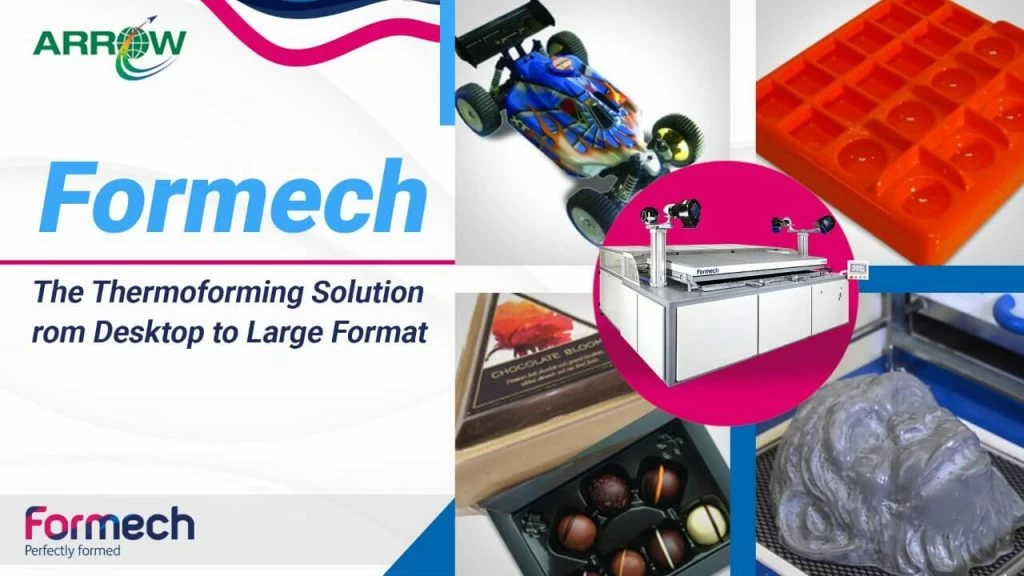
Formech desktop machines bring industrial vacuum forming into lab, studio, and classroom environments with a compact footprint.

The desktop range is suited to first-time thermoforming users, industrial designers, R&D teams, students, and small production runs where space is limited.

Model

Forming Area

Best For

Formech Compact Mini

Small (bench-top)

Education, concept prototyping, material testing

Formech 450 DT

450 mm × 300 mm

Design studios, small-batch packaging prototypes

Formech 508 DT

508 mm × 457 mm

Mid-scale prototyping, lab environments, SMEs

All desktop models are available in India through Arrow Digital Pvt. Ltd. and are backed by local technical support.

Formech Large Format Series — Signage, Automotive, and Retail

Formech large format machines handle forming areas up to 2440 × 1220 mm — suitable for full-panel automotive trim, large signage, and retail display production.

Model

Forming Area

Max Sheet Size

Primary Applications

Formech 1372

1372 × 762 mm

1524 × 914 mm

Retail POS, signage, packaging

Formech 1250

1250 × 750 mm

1400 × 900 mm

Interior panels, display units

Formech 1500

1500 × 1000 mm

1650 × 1150 mm

Automotive trim, aerospace panels

Formech 2440

2440 × 1220 mm

2590 × 1370 mm

Large-scale signage, film & theatre set pieces

Formech large format machines are used in India for transit advertising panels, illuminated retail signage, automotive component prototyping, and film set fabrication.

Combining Digital Printing with Thermoforming

Digitally printing onto a thermoplastic sheet before vacuum forming converts flat 2D graphics into dimensional, illuminated 3D display objects.

This print-and-form workflow is used by PSPs and display fabricators to produce premium retail displays, illuminated signage, and branded POS units — at far lower tooling cost than traditional injection moulding.

Recommended Workflow

Step

Process

Equipment / Material

1

Digital print

Print the design onto thermoformable sheet using EFI H1625-SD with EFI TF inks

2

Mould preparation

Produce the forming mould via Massivit 3D printer or CNC machining

3

Vacuum forming

Form the printed sheet over the mould using a Formech large format machine

4

Trimming

Trim formed part using Kongsberg cutting table or manual router

5

Finishing

Apply EFI TF outdoor coatings for UV, scratch, and weather resistance

EFI TF inks are formulated to stretch with the plastic sheet during forming without cracking or colour shift — a critical requirement for outdoor-rated thermoformed signage.

FAQ — Formech Thermoforming Machines in India

Common questions from Indian print shops, display fabricators, and industrial buyers considering Formech vacuum forming equipment.

Vacuum forming is a subset of thermoforming. In vacuum forming, a heated plastic sheet is shaped using vacuum suction alone. Some advanced thermoforming processes also apply positive air pressure to achieve sharper detail — this is sometimes called pressure forming or twin-sheet forming.

For retail signage, POS displays, and illuminated lettering, the Formech 1372 or Formech 1500 are the most commonly used models. The Formech 2440 is suited to extra-large-format production such as full transit panel displays or large-format set pieces.

Yes. Using thermoformable inks (such as EFI TF inks) on compatible sheets, you can digitally print a flat graphic and then vacuum form it into a 3D shape. The inks are formulated to stretch with the plastic without cracking. EFI H1625-SD printers are compatible with this workflow.

Formech machines are compatible with ABS, HIPS, PETG, Acrylic (PMMA), PVC, Polycarbonate (PC), HDPE, and many other thermoplastic sheet materials. Material suitability depends on forming temperature and the specific machine model.

Formech machines are distributed in India exclusively by Arrow Digital Pvt. Ltd. Arrow Digital provides equipment, installation, training, and ongoing technical support across India.

For large parts (above 500 mm in any dimension), thermoforming is typically faster and more cost-effective than 3D printing. Thermoforming also produces a smoother, paintable, and digitally printable surface. 3D printing remains better suited to highly complex geometries in small quantities.

Get a Formech Demo at Arrow Digital

Arrow Digital Pvt. Ltd. is the authorised Formech distributor in India. Request a live machine demonstration, get a quotation, or speak to a thermoforming specialist.