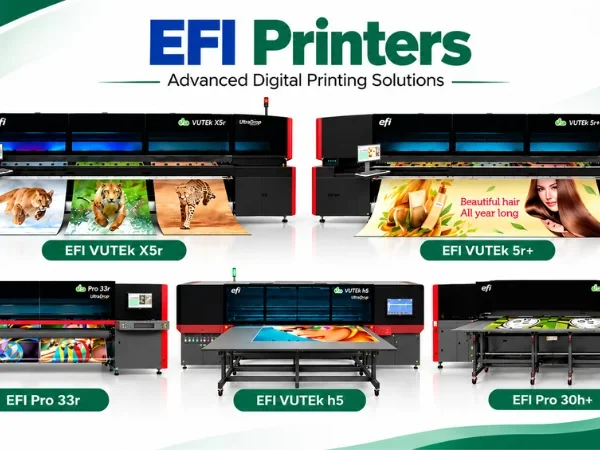
7 Reasons to Buy EFI Printers for Your Print Business in India
Table of Contents 7 Reasons to Buy EFI Printers for Your Print Business in India EFI printers let one print business serve signage, soft signage,


Effective outdoor banners deliver one clear message, use high-contrast colours, and are sized for the viewer’s distance — all within a 3-to-5-second attention window.

Outdoor banners cannot be ad-blocked, carry no recurring media cost, and build local brand recall with every impression — advantages no digital channel can replicate.
Despite the dominance of digital advertising, outdoor banners continue to deliver measurable results for businesses of all sizes. Four structural advantages explain their staying power:
Advantage | Why It Matters |
|---|---|
Cannot be ad-blocked | Viewers cannot skip or hide physical banners the way they suppress digital ads. |
One-time production cost | Unlike paid digital campaigns, a printed banner runs indefinitely with zero ongoing spend. |
Local brand recall | Repeated exposure in a neighbourhood builds familiarity and top-of-mind awareness. |
No algorithm dependency | Reach is determined by foot and vehicle traffic, not platform logic or bid prices. |
Before choosing any design element, define the banner’s goal, target viewer profile, and exact placement location.
Every design decision — size, font weight, colour, and message length — flows from three foundational questions:
Answering these before opening a design file prevents costly reprints and ensures every creative choice serves the actual communication objective.
Outdoor viewers have 3–5 seconds to read a banner — limit copy to one message and one call-to-action.
The single biggest mistake in outdoor banner design is information overload. A viewer moving at walking or driving pace cannot process multiple competing messages. The one-message rule is non-negotiable.
Type | Example |
|---|---|
Avoid | Welcome to ABC’s Mega Festive End-of-Season Year-End Clearance Sale on All Products! |
Recommended | 50% OFF Everything | This Week Only | Visit ABC Store |
Choose banner colours for emotional impact and legibility contrast; test readability from at least 10 metres before finalising any design.
Colour choices in 2025 trend toward vibrant gradients, neon accents, and high-contrast pairings. The table below maps common colours to their psychological signals and strongest banner use cases:
Colour | Psychological Signal | Strongest Use Case |
|---|---|---|
Red | Urgency, excitement | Flash sales, clearance, limited-time offers |
Blue | Trust, calm | Healthcare, finance, professional services |
Yellow | Attention, optimism | Event banners, food & beverage, promotions |
Green | Growth, eco-awareness | Sustainability claims, natural products |
Black | Premium, authority | Luxury brands, high-end retail |
Orange | Energy, action | Sports, fitness, youth-oriented brands |
Critical rule: Text colour must contrast sufficiently with background. Test the final design printed at scale from the intended viewing distance before approving production.
Use bold sans-serif fonts sized for the viewing distance; avoid script or decorative typefaces, which lose legibility at scale.
Font selection is a legibility decision as much as an aesthetic one. The following typefaces perform consistently well on large format print in 2025:
Font | Style | Best For |
|---|---|---|
Montserrat | Geometric sans-serif, clean weight range | Corporate banners, event signage |
Bebas Neue | All-caps condensed, high impact | Retail promotions, sports events |
Oswald | Semi-condensed, strong verticals | Roadside banners, headline use |
Poppins | Rounded geometric, approachable | Consumer brands, community events |
What to avoid: Script fonts, thin weights (below 400), and all-lowercase styling reduce legibility sharply at large format sizes and from a distance.
Banner size must match the viewing context — roadside, retail frontage, and event booth each require different dimensions and mounting considerations.
Standard Size | Context | Typical Application |
|---|---|---|
6 ft × 3 ft (180 × 90 cm) | Small business storefront | Shop window, entrance gate, small event booth |
8 ft × 4 ft (240 × 120 cm) | Retail or mid-size venue | Retail fascia, exhibition stand, conference backdrop |
20 ft × 6 ft (600 × 180 cm) | Roadside / highway | Hoarding banner, outdoor commercial signage |
Viewing angle matters: A banner at driver eye-level on a highway needs different text sizing than one mounted 3 metres high above a pedestrian entrance. Always mock up the artwork at intended print size before signing off.
All artwork must be supplied at 300 DPI minimum; pixelated images at large print sizes directly damage brand credibility.
Large format printing magnifies every image quality issue. Use only:
A banner CTA should be 2–5 words, action-oriented, and placed within the first visual zone a viewer encounters.
The call-to-action is the only element that converts attention into response. It must be:
CTA Type | Example | When to Use |
|---|---|---|
Urgency | Sale Ends Friday | Time-limited promotions |
Benefit | Call for Free Quote | Service businesses, B2B |
Footfall | Visit Us Today | Retail, local services |
Digital bridge | Scan for Offer | Events or static locations with dwell time |
In 2025, QR codes remain effective on banners placed where viewers have dwell time — events, waiting areas, and static retail frontages. They are less effective on roadside banners where scanning is impractical.
Brand consistency across outdoor banners — colours, logo placement, and tone — builds recall and audience trust over repeated exposure.
Even the boldest design experiment must stay within brand guardrails. Apply these three rules on every banner:
PVC-free banner substrates, fabric materials, and UV-cured inks are now widely available and competitively priced for large format outdoor printing.
Material / Ink Type | Environmental Benefit | Best Application |
|---|---|---|
PVC-free banner media | Eliminates vinyl chloride from production and disposal | Outdoor banners, event signage |
Fabric banners (polyester) | Recyclable, reusable, reduced packaging | Indoor events, exhibition stands |
UV-cured inks | Near-zero VOC emissions during curing | Outdoor large format, substrate versatility |
Recyclable correx / board | Curbside recyclable in most markets | Short-run POS displays, event banners |
Brand positioning opportunity: Printing “Produced on eco-friendly media” on the banner itself is a low-cost brand trust signal that resonates with environmentally aware audiences.
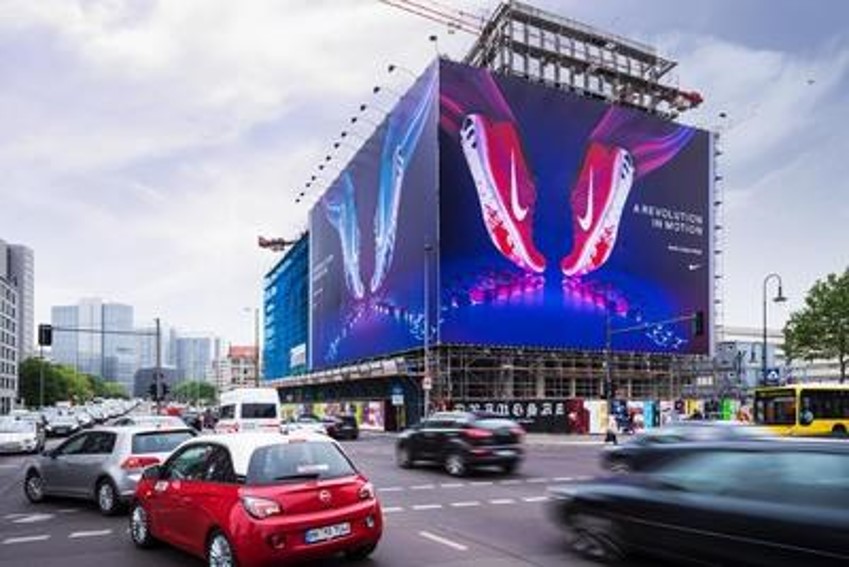
Five trends define high-performing outdoor banner design in 2025: motion-inspired visuals, bold minimalism, AI-assisted layouts, interactive QR codes, and reflective or UV inks.
Trend | What It Means in Practice |
|---|---|
Motion-inspired visuals | Static graphics that suggest movement through directional blur, speed lines, or sequential shape progression. |
Bold minimalism | One dominant visual element, maximum two typefaces, significant negative space. Impact through restraint. |
AI-assisted layout | AI tools used to generate layout variations, test colour combinations, and optimise visual hierarchy before production. |
Interactive QR banners | QR codes linking to AR demos, lead-gen forms, video walkthroughs, or exclusive discount pages. |
UV and reflective inks | UV-reactive and retroreflective inks that maintain visibility after dark — extending banner effectiveness to 24 hours. |
The most effective banners share three traits: a single sharp hook, clear timing information, and one unambiguous next action.
Element | Example |
|---|---|
Banner copy | GRAND OPENING — 30% OFF | 25–27 March | Main Street |
Why it worked | Short copy, urgency from specific dates, single CTA implied by location mention. |
Element | Example |
|---|---|
Banner copy | LIVE MUSIC NIGHT | DJ Zara | Every Saturday 7 PM | Scan QR for Tickets |
Why it worked | Recurring schedule creates repeat impressions; QR provides a frictionless response path. |
Element | Example |
|---|---|
Banner copy | Free Eye Check-up | 28–30 March | Smile Vision Clinic |
Why it worked | Free service hook lowers barrier to response; clinic name builds local brand recall. |
Answers to the most common questions about outdoor banner design, sizing, materials, and production specifications.
Supply artwork at 300 DPI at final print size. For very large formats (above 5 metres wide), 100–150 DPI at print size is acceptable because viewing distance increases proportionally.
Aim for fewer than 10 words of primary message copy. Include a headline, one key detail (date, discount, or offer), and a CTA. Viewers at driving speed have 3–5 seconds — every additional word reduces comprehension.
PDF (print-ready) is the standard. Alternatively, supply AI or EPS files with fonts outlined and images embedded. TIFF at 300 DPI is acceptable for photo-only banners. Avoid JPEG for text-heavy artwork due to compression artefacts.
A common rule of thumb: 2.5 cm of letter height per 3 metres of viewing distance. For a roadside banner viewed from 30 metres, primary headline text should be at least 25 cm tall. At A4 document scale, this equates to approximately 70–80 pt depending on typeface.
Modern PVC-free banner substrates perform comparably to vinyl in outdoor conditions when UV-laminated. Fabric banners (polyester) offer equivalent durability for temporary outdoor use and are fully recyclable.
Roadside banners at driving speed are not suitable for QR codes. QR codes on outdoor banners work best where viewers have dwell time: event entrances, retail storefronts, bus stops, and exhibition stands.
When publishing banner design content online, ensure images carry descriptive alt-text (e.g., ‘retail outdoor banner design for grand opening 2025’), headings use descriptive ID anchors, and any specification data appears in structured tables rather than unformatted lists.
Table of Contents 7 Reasons to Buy EFI Printers for Your Print Business in India EFI printers let one print business serve signage, soft signage,
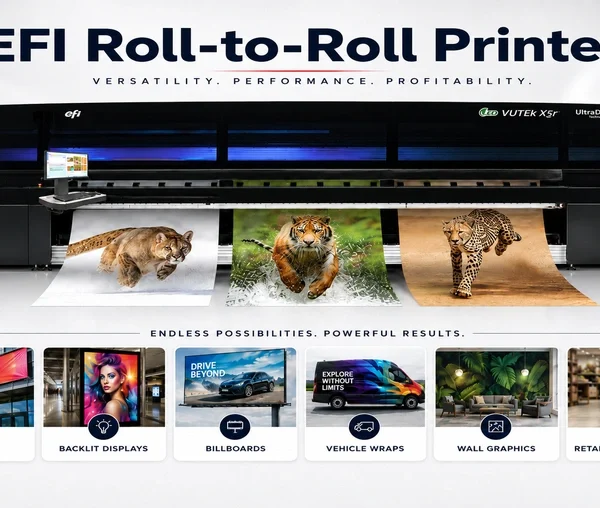
Table of Contents Why You Need EFI Roll-to-Roll Printers for Special Applications EFI VUTEk roll-to-roll printers become all-in-one production platforms with value-added accessories for finishing,
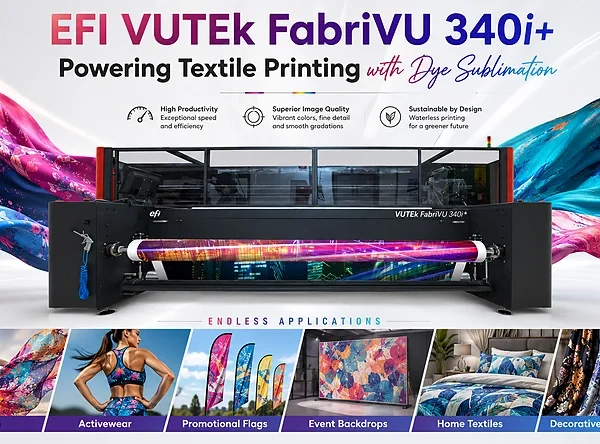
Table of Contents EFI VUTEk FabriVU 340i+ Dye Sublimation: A Great Choice for Textile Printing The EFI VUTEk FabriVU 340i+ prints and fixes fabric graphics
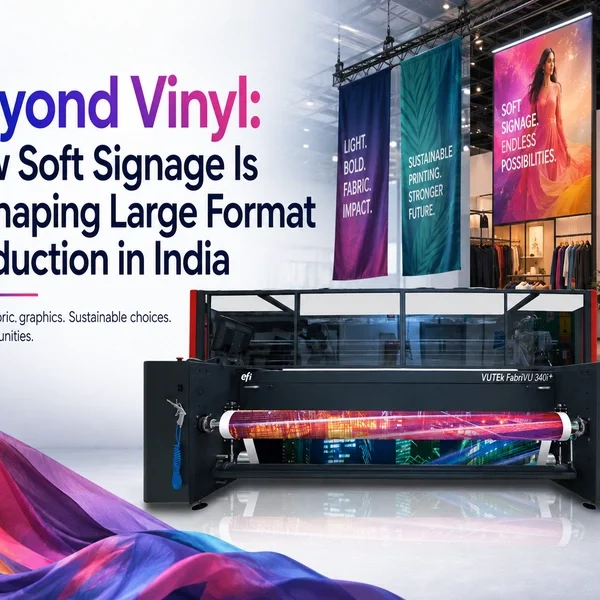
Table of Contents Beyond Vinyl: How Soft Signage Is Reshaping Large Format Production in India Print buyers across retail, events, and hospitality have been moving
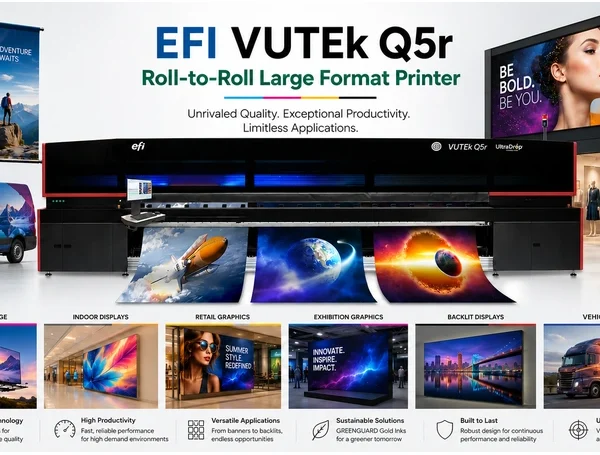
Table of Contents EFI VUTEk Q5r Roll-to-Roll Large Format Printer:Production Capabilities and Ink Options India’s large format print market is being shaped by one consistent
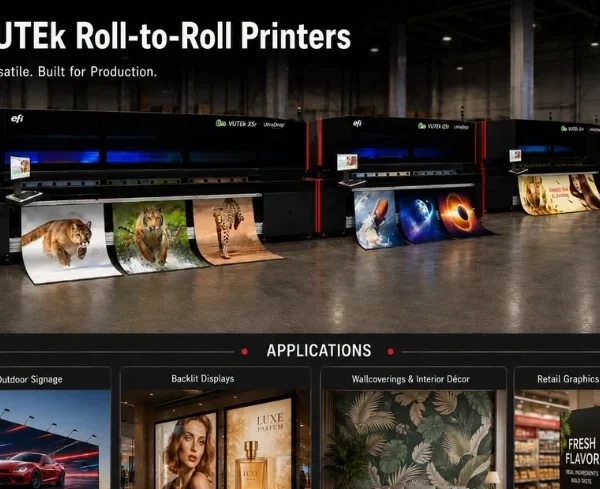
Table of Contents EFI VUTEk Roll-to-Roll Printers: The Complete Lineup Guide for Indian Large Format Print Producers India’s large format print producers evaluating UV roll-to-roll