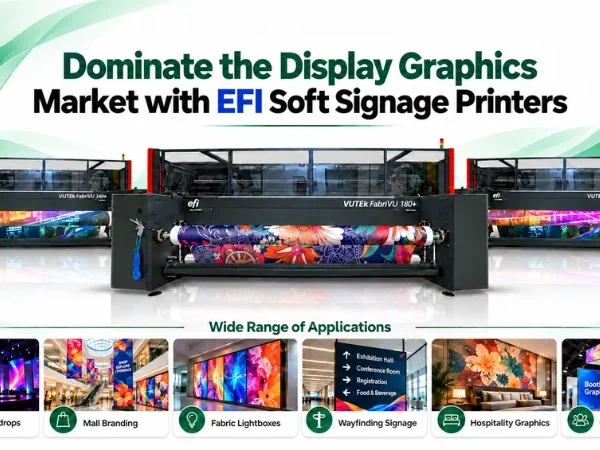
Dominate the Display Graphics Market with EFI Soft Signage Printers
Table of Contents Dominate the Display Graphics Market with EFI Soft Signage Printers EFI VUTEk FabriVU printers let your shop produce fabric display graphics, from

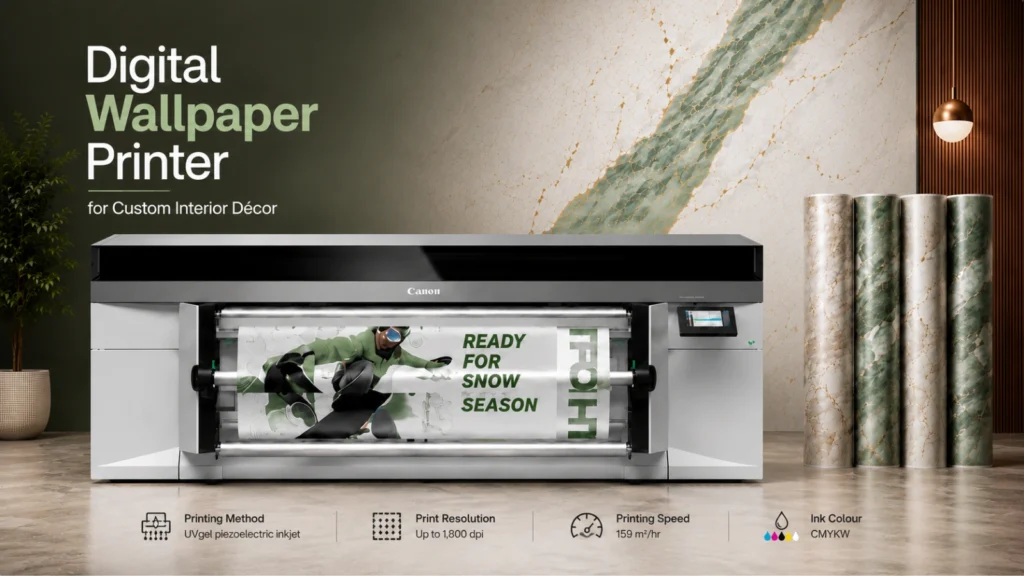
Choosing the right digital wallpaper printer determines production quality, throughput, and substrate range for interior décor applications.
The equipment decision is more specific than it first appears. Wallpaper production imposes requirements on ink chemistry, dimensional accuracy, substrate handling, finish versatility, and finishing integration that differ from standard large format signage or display work. This guide covers what those requirements are, how to evaluate equipment against them, and what a complete production setup looks like.
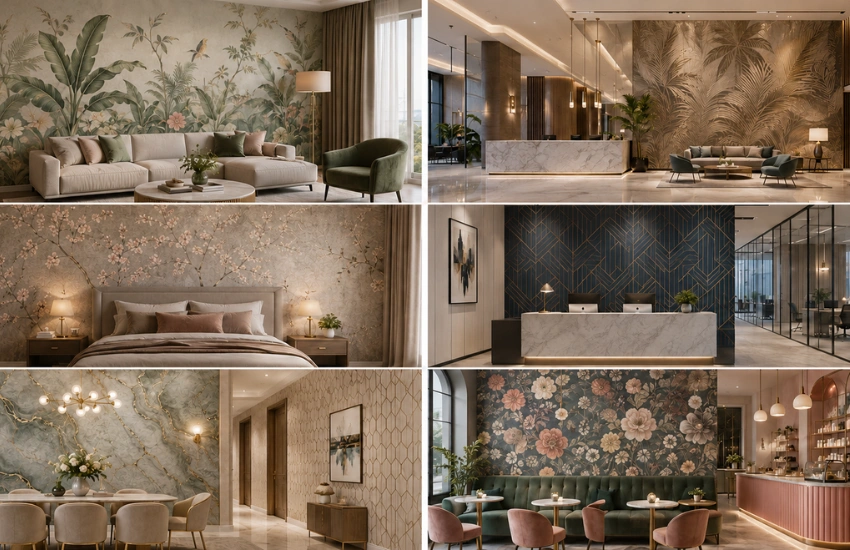
The way commercial and residential interiors are designed has shifted considerably over the past decade. Custom wall coverings — once associated primarily with luxury segment interiors — are increasingly standard across hospitality fitouts, retail brand environments, corporate office spaces, and residential projects in India.
What is driving this is largely a change in how interior design briefs are written. Designers and specifiers are no longer selecting from catalogues of stock patterns. They are requesting custom murals, branded environments, and room-specific designs produced on demand, often in short batches with fast turnaround requirements.
For large format print producers, this is a real production opportunity. Wallpaper is a high-margin, short-run category. Jobs tend to be customised, which limits the viability of conventional print manufacturing. Digital production removes the plate cost, eliminates minimum order constraints, and allows every panel to differ.
The entry barrier is primarily equipment. The substrate handling, ink requirements, finish versatility, and finishing workflow for wallpaper production differ significantly from standard signage or banner work — and that is where the equipment decision needs to start.
A large format printer used for outdoor signage or vehicle graphics is optimised for a different set of production requirements than one intended for wallpaper. Understanding those differences is the starting point for an informed equipment decision.
Ink chemistry. Wallpaper is installed indoors — in bedrooms, hotel rooms, hospital corridors, and retail environments. Inks that contain solvents or emit VOCs after curing are unsuitable. The environment requires inks that are genuinely odourless after print and certified for indoor use.
Dimensional accuracy. Wallpaper is produced in panels that must align when hung — seam to seam, edge to edge, repeat to repeat. Dimensional stability during printing and controlled dot placement across the full roll width are non-negotiable. A millimetre of drift across a multi-panel installation is visible on the wall.
Substrate range. Wallpaper is printed on non-woven media, textured papers, PVC-free substrates, and smooth-coated papers — each with different ink absorption, thickness, and surface behaviour. The printer must handle this range without distortion or banding.
Finish output. Interior design specifications frequently call for a specific finish — matte for a premium residential feel, gloss for high-impact retail, or a mixed-finish approach for creative effect. Equipment that requires an ink or media change to switch between finishes adds cost and complexity to every job.
Finishing integration. Wallpaper is not a finished product off the printer. It needs to be cut to panel width, cut to strip length, and rewound for delivery. This requires a purpose-built finishing companion — not the general-purpose cutter used for banners and signage.
UVgel is Canon’s proprietary large-format inkjet printing technology. It combines gel-based ink deposition with instant pinning and delayed UV LED curing. Ink drops return to a gel state on contact with the substrate and are pinned before final LED curing — helping control dot gain, image sharpness, finish consistency, and durability across wallpaper production. Four output properties follow directly from this process.
Rich colours, sharp details Precise dot placement with no dot gain delivers outstanding colour quality and consistency across a wide colour gamut, with sharp details and strong saturation — including for dark colours. | Velvety matte finish UVgel ink drops are pinned to the media instantly before LED curing, producing a stunning velvety matte finish on a wide variety of media, including uncoated and vinyl substrates. |
Odourless prints UVgel prints are certified for immediate indoor use, even in sensitive environments such as schools and healthcare facilities. No VOCs, no odour after curing. | Robust, consistent output Prints are scratch and scuff resistant, making them less susceptible to damage. Dot placement control ensures consistently repeatable images over time and across different machines. |
The consistency dimension here is particularly relevant for commercial wallpaper jobs. Repeatable images over time and across different machines means a multi-room hotel installation can be produced across separate print runs and still match — panel for panel — at the point of application. That is a production requirement, not a marketing claim.
FLXfinish+ is a feature of the UVgel Wallpaper Factory system that allows the printer to produce matte, gloss, or a combination of both finishes within the same print run — without changing the ink or the media. It works by controlling how the ink is pinned and subsequently cured with LED light, varying the surface texture selectively across the print.
For wallpaper production, this removes a common workflow complication. A design that specifies a matte background with gloss detail elements — a popular choice in premium residential and hospitality interiors — can be produced in a single pass. No media swap, no reprinting, no additional finishing step.

The UVgel Wallpaper Factory is Canon’s modular production solution for high-volume digitally printed wallpaper. It is designed as a complete, automated production workflow — from bulk media input through to finished, rewound output ready for delivery. The system is built to run continuously, with minimal manual intervention at any stage.
The system runs in four sequential stages:
Automation across the workflow
Jumbo roll input eliminates media reload interruptions. Dual roll switching handles media type changes without downtime. Inline cutting and rewinding run immediately after print, removing the manual handling stage between print and dispatch. The result is a production line that can run at scale with a small operator footprint.
The UVgel Wallpaper Factory supports a broad range of wallpaper substrates in a single configuration:
This substrate range means a single production setup can serve multiple customer segments — from residential interiors specifying eco-conscious PVC-free media through to retail environments requiring durable vinyl-based wall coverings. The UVgel ink system’s ability to produce a velvety matte finish on uncoated and textured substrates — without requiring a coated media — extends the usable substrate range further than standard UV inkjet.
GREENGUARD Gold Certified
UVgel inks used in the Wallpaper Factory system are GREENGUARD Gold certified, making the output safe for use in sensitive environments including schools, hospitals, and residential spaces. No harmful VOCs. No residual odour. Prints are certified for immediate indoor use following installation.
The wallpaper production segment is well-suited to large format print operations that already serve commercial interiors. For a broader look at how Canon Colorado fits the décor production segment in India, see our page on Canon for home décor production.
In India, the hospitality sector represents a consistent demand source. Hotel chains routinely require branded and custom wallpaper for property rollouts, refurbishments, and theme-specific installations — often with tight production timelines and panel-accurate repeat requirements. Retail environments — branded stores, mall interiors, and experience-format spaces — follow a similar pattern. Premium residential interiors in urban markets are a growing segment for custom digital wallpaper.
For print producers currently operating in signage or display graphics, wallpaper is a natural adjacency. The production logic — short run, custom design, fast delivery — is familiar. The primary requirement is a print and finishing setup engineered for the substrate, the finish, and the dimensional accuracy that wallpaper demands. Operations with existing customer relationships in commercial interiors are positioned most directly to convert those relationships into wallpaper production volume.
Large format roll-to-roll inkjet printers with odourless, indoor-certified inks are the standard equipment for digital wallpaper production. Ink type is a primary consideration — solvent and standard UV inks are not suitable for indoor environments. UVgel and latex ink systems are the appropriate options. UVgel adds the benefit of a velvety matte finish on uncoated and textured media, which is particularly relevant for premium wallpaper applications.
FLXfinish+ is a feature of the UVgel Wallpaper Factory system that allows matte, gloss, or combined finishes to be produced in a single print run, without changing the ink or the media. For wallpaper, this means mixed-finish designs — such as a matte background with gloss detail elements — can be produced in one pass, removing the need for additional finishing steps or separate production runs.
The UVgel Wallpaper Factory is a four-component modular system: a Fotoba Jumbo Roll JRL 170 media feeder, a Canon Colorado M5W print engine (with UVgel and white ink as standard), a Fotoba XLD 170 WP wallpaper cutter (minimum cut 8×12 cm), and a Fotoba REW 162 rewinder. The system is designed for automated, high-volume production from input roll to finished, rewound output.
Yes. Wallpaper requires precision cutting to specific panel widths and strip lengths in both X and Y axes. A purpose-built wallpaper finisher — such as the Fotoba XLD 170 WP with a minimum cut of 8×12 cm — is required. General-purpose large format cutters are not configured for wallpaper panel dimensions or the repeat-accurate cutting that multi-panel installations demand.
When produced with GREENGUARD Gold certified UVgel inks, yes. UVgel prints are certified for immediate indoor use, including in sensitive environments such as healthcare facilities and schools. No harmful VOCs are emitted, and there is no residual odour after curing — the key requirement for installation in occupied or sensitive spaces.
To see how the Canon Colorado M5W and the UVgel Wallpaper Factory perform in a live production environment, request a demo through Arrow Digital India.
Table of Contents Dominate the Display Graphics Market with EFI Soft Signage Printers EFI VUTEk FabriVU printers let your shop produce fabric display graphics, from
Table of Contents 7 Reasons to Buy EFI Printers for Your Print Business in India EFI printers let one print business serve signage, soft signage,
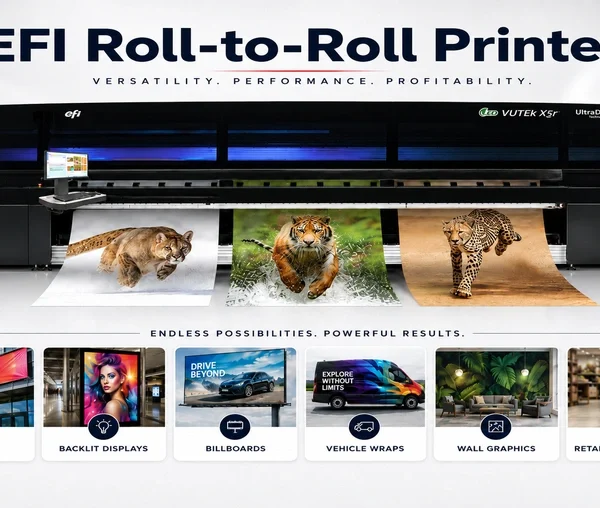
Table of Contents Why You Need EFI Roll-to-Roll Printers for Special Applications EFI VUTEk roll-to-roll printers become all-in-one production platforms with value-added accessories for finishing,
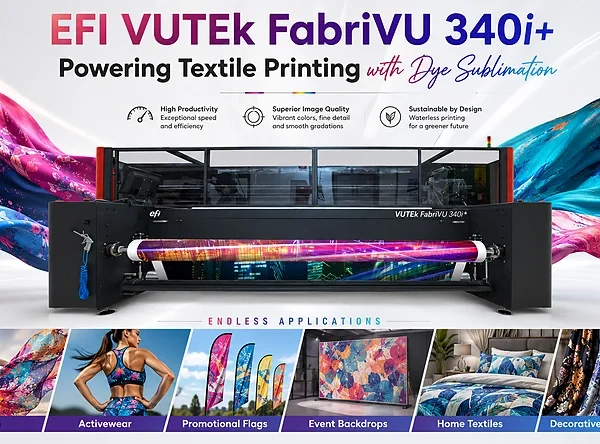
Table of Contents EFI VUTEk FabriVU 340i+ Dye Sublimation: A Great Choice for Textile Printing The EFI VUTEk FabriVU 340i+ prints and fixes fabric graphics
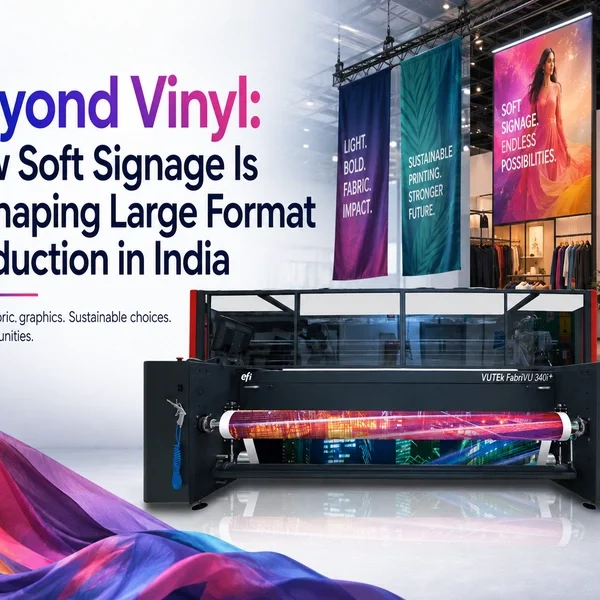
Table of Contents Beyond Vinyl: How Soft Signage Is Reshaping Large Format Production in India Print buyers across retail, events, and hospitality have been moving
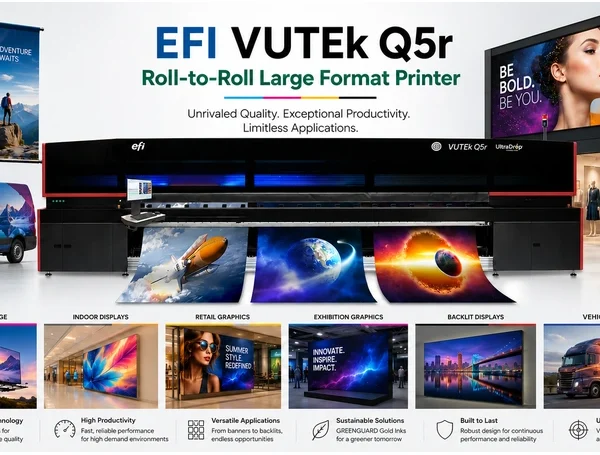
Table of Contents EFI VUTEk Q5r Roll-to-Roll Large Format Printer:Production Capabilities and Ink Options India’s large format print market is being shaped by one consistent
Discover new ways to print and finish labels with Arrow Digital.
Explore aqueous pigment printing, flexible short runs and precision die-cutting.
2026 · THURSDAY–SUNDAY
Greater Noida, Delhi NCR.